
Wrestlers
Wrestlers is the modern name for a Hellenistic Greek sculpture, probably originally in bronze, known through a Roman marble copy preserved in the Uffizi Gallery in Florence. The group depicts a sporting combat in the pancratium: one fighter has pinned his opponent, gripping his right arm, while the loser kneels, nearly fallen, with his back sharply bent and one hand braced on the ground. The musculature is strongly exaggerated to emphasize physical effort. The original heads were lost and replaced after discovery; the head of the defeated figure is earlier and stylistically more advanced, while the victor’s head is modern. The work was once highly esteemed and is now usually assigned to the Pergamene school or the circle of Lysippus.
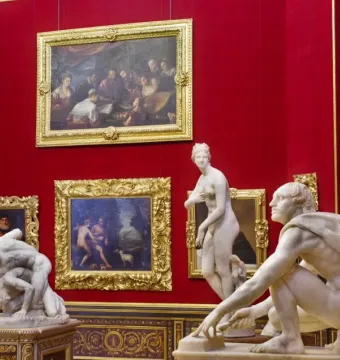
March 2015 © Paolo Villa · CC BY-SA 4.0
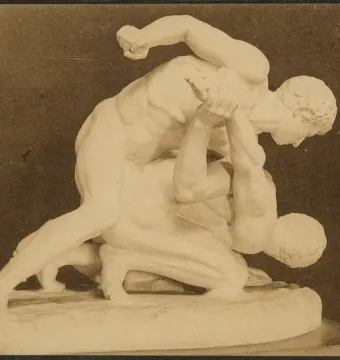
© Unknown authorUnknown author · Public domain
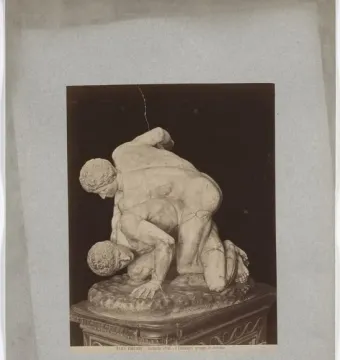
© Giacomo Brogi · PDM-owner
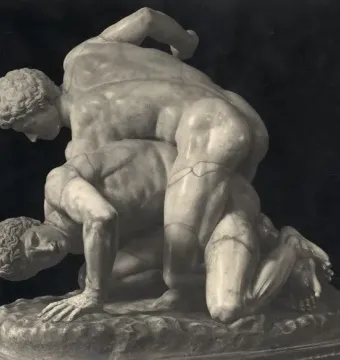
1910 © Internet Archive Book Images · No restrictions
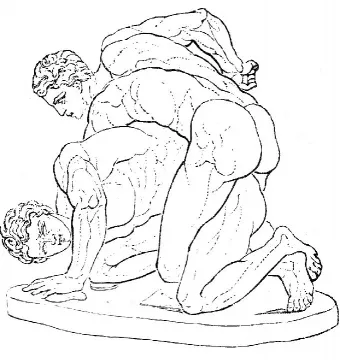
1875 © Ernst Wallis et al · Public domain
Identification | |
| Title | Wrestlers |
| Type | Roman marble sculpture group |
| Subject | Two nude young men engaged in pankration |
| Alternative titles | Luchadores; Pancraciasts; Pancrastinae; Les Lutteurs; The Two Wrestlers; Los luchadores; Uffizi Wrestlers; Wrestlers of the Uffizi |
Historical context | |
| Date of creation | 1st century CE |
| Original Greek model date | 3rd century BCE |
Creator | |
| Artist | Unknown Roman artist |
| Original attribution | Attributed variously to Myron, Cephisodotus the Younger, Heliodorus, Lysippus, or the Pergamene school; modern scholarship also suggests Lysippus or his followers |
Discovery and provenance | |
| First owner after discovery | The Varese family |
| Current display | On display in the Tribune Hall |
| Current location | Uffizi Gallery, Florence, Italy |
| Transfer to Florence | 1677 |
| Later location | Villa Medici, Rome |
| Associated find | Found together with the Niobids group |
| Acquisition | Purchased on 25 June 1583 by Cardinal Ferdinando de' Medici through a member of the Varese family, for the Villa Medici collection |
| Documentation of discovery | The discovery was well documented and caused a sensation in Rome |
| Early interpretation | Early antiquarians and engravers wrongly thought it belonged to the Niobids group as a single composition |
| Condition at discovery | The sculpture was found without its heads |
| Discovery place | A vineyard of the Tommasini da Gallese family near Porta San Giovanni in Rome |
| Discovery date | Late March or early April 1583 |
Physical characteristics | |
| Restored parts in Florence | The right arm of the upper figure was restored there |
| Heads | Both heads were added after discovery; the lower head used an ancient fragment and the upper head was made by a restorer |
| Surface condition at discovery | Covered with a greasy patina that was removed |
| Copy status | Roman copy of a lost Greek bronze original |
| Material | Parian marble |
Appearance | |
| Figures | Two muscular nude men in combat |
| Pose | One wrestler is mounted astride the other, pressing him down and twisting his arm while trying to hook his left leg around the opponent's left leg; the lower wrestler is kneeling, braced on one arm, with his other arm pulled back |
| Head positions | The upper wrestler looks down at his opponent; the lower wrestler turns his face to the left |
| Anatomical treatment | The anatomy and proportions are carefully worked out and strongly emphasized |
| Style | Highly realistic and dynamically composed |
| Facial expression | Despite the struggle, both figures have calm expressions |
| Mood | Aggressive combat contrasted with self-control |
| Viewer effect | The interlocking bodies create a striking visual effect and were noted for evoking admiration |
Iconography and meaning | |
| Interpretation | Some researchers note erotic tension in the statue |
| Depicted sport | Pankration, an ancient Greek combat sport |
Location and ownership | |
| Ownership history | After discovery it passed from the Varese family to the Medici collection, and later to the Uffizi |
| Early display history | It was a प्रमुख work in the Tribune of the Uffizi |
History and restoration | |
| Popularity | It was once very famous and widely copied |
| Copies | Many copies were made in marble, bronze, plaster, and modern resin; Philippe Magnier made a marble copy ca. 1684–1687 for Versailles, later moved to Marly and now in the Louvre |
| Historical reputation | Once considered one of the most important works of antiquity |
| Later critical reception | Its reputation later declined; Kenneth Clark described it as a work once famous and now unfairly neglected |
| Critical interpretation | Kenneth Clark suggested that the original was a Lysippic bronze of masterly complexity and condensation |
Significance | |
| Pliny reference | Pliny used the term symplegmata for closely intertwined figures in struggle and cited Cephisodotus the Younger and Heliodorus as makers of such works |
| Symplegmata meaning | Figures closed in struggle, whether purely physical or amatory |
| Example cited by Pliny | Pan and Olympus in the Portico of Octavia |
Other | |
| Identification note | Not to be confused with Pugilist at Rest or Wrestler (Olmec sculpture) |
| Image files mentioned | Uffizi_wrestlers.jpg; Uffizi_wrestlers-2.jpg; Uffizi_wrestlers-3.jpg |