
Throne of Maximian
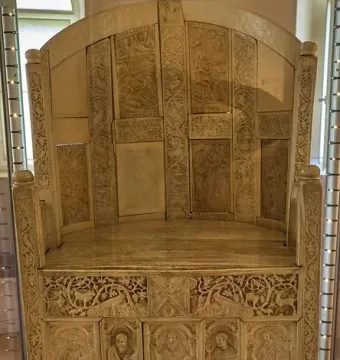
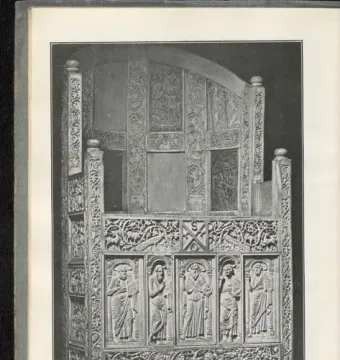
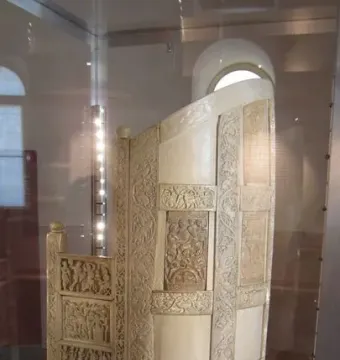
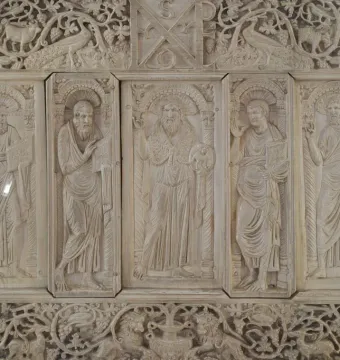
Throne of Maximian is an ivory-carved throne made for Archbishop Maximian of Ravenna. It is now on display in the Archiepiscopal Museum of Ravenna. The throne is generally believed to have been carved in the Greek East of the Byzantine Empire, though scholars have long debated whether it was made in Constantinople or Alexandria. Its style combines Early Christian art with the First Golden Age of Byzantine art. Built on a wooden frame, it is decorated with carved ivory panels and vine borders. The reliefs show scenes from the Life of Christ, the Story of Joseph, and the Four Evangelists around John the Baptist, who holds a medallion with the Lamb of God.
May 2023 © Graeme Churchard · CC BY 2.0
© Georg Vitzthum von Eckstädt · Public domain
© Perkele · Public domain
November 2015 © GFreihalter · CC BY-SA 3.0
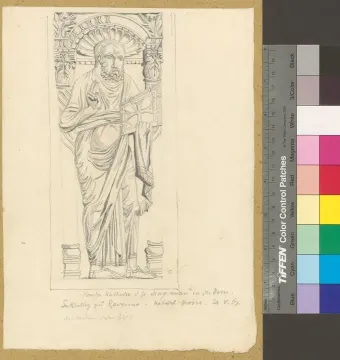
1867 © Johann Rudolf Rahn · Public domain
Identification | |
| Title | Throne of Maximian |
| Type | Episcopal throne (cathedra) |
| Alternative names | Cátedra de Maximiano; Maximianus; Episcopal throne of Maximian; Maximian's Cathedra; Кафедра Максимиана; Tron Maksymiana |
Historical context | |
| Date | Mid-6th century; about 545–553; exact date unknown and debated |
| Historical context | Made after Ravenna was conquered by Byzantine forces under Justinian I in 540, during the reign of Justinian I |
Creator | |
| Artist / maker | Unknown; probably several Byzantine artists |
| Patron / commissioner | Possibly Emperor Justinian I; associated with Archbishop Maximian of Ravenna |
| Place of manufacture | Uncertain; possibly Constantinople, Alexandria, Syria, Ravenna, or the Greek East of the Byzantine Empire |
Discovery and provenance | |
| Made for | Archbishop Maximian of Ravenna |
| Identification basis | Interpretation of the monogram on the front panel reading MAXIMIANVS EPISCOPVS ('Maximian bishop') |
| Function / intended use | Probably used as an episcopal seat for the bishops of Ravenna; its actual function is unclear and it may instead have served as a symbolic throne for sacred books or as an empty throne representing divine or imperial authority |
| Original location | The cartilogio of the ancient Ursine Cathedral of Ravenna |
| Current location | Archiepiscopal Museum of Ravenna, Ravenna |
| Provenance notes | First mentioned in the 10th-century Chronicon Venetum; later sources appear in 1664; rediscovered in 1919 |
History and restoration | |
| Restoration history | Restored in the 1930s, with a second restoration in 1956; missing ivory panels were replaced with wooden boards covered in parchment and some recovered panels were reintegrated |
Physical characteristics | |
| Structure | Wooden frame covered with carved ivory panels |
| Panel count | Originally 26 or 39 carved panels; 27 panels survive, including 16 back panels that survive or were restored |
| Dimensions | About 1.50 m high and 0.60 m wide |
| Form | Large throne with a high semicircular back |
Materials | |
| Materials | Ivory and wood; some missing panels were replaced with wooden boards covered in parchment |
| Technique | Ivory carving in relief |
Appearance | |
| Decoration | Richly decorated with vegetal ornament, vine-scroll frames, birds and animals, and biblical scenes |
| Carved frame | Carved panels with winding vine and grapevine frames |
| Appearance | Simple, well-proportioned lines combined with elaborate carvings |
Iconography and meaning | |
| Interpretation | The Joseph cycle was likely chosen for its relevance to a bishop's civil-government role; the object also alludes to the bishop's teaching function and pastoral authority |
| Side decoration | Scenes from the History of Joseph / the Story of Joseph from Genesis |
| Back decoration | Scenes from the Life of Christ |
| Front decoration | The Four Evangelists around John the Baptist, who holds a medallion with the Lamb of God; Maximian's name appears above him |
| Iconographic content | Scenes from the Life of Christ, the Story of Joseph from Genesis, the Four Evangelists, John the Baptist, and other biblical figures |
Location and ownership | |
| Current display | Ravenna |
| Associated person | Maximian, archbishop of Ravenna (bishop of Ravenna; consecrated in 546; in office 546–554) |
| Associated ruler | Justinian I |
Significance | |
| Stylistic classification | Early Christian and early Byzantine ivory sculpture; stylistically related to Greco-Oriental, Coptic, and Syrian art |
| Significance | The largest ivory piece surviving from Late Antiquity and a rare type of furnishing |
| Scholarly status | The date, origin, commissioner, and function are debated; origin has been proposed as Constantinople, Alexandria, Syria, Ravenna, or the Greek East of the Byzantine Empire |
Other | |
| Notes | A possible former feature was a jeweled cross or Gospel book; four carvers are mentioned in one account; the throne may have been designed to be movable and carried in ceremonies |