
Elephant with Salt Cellar
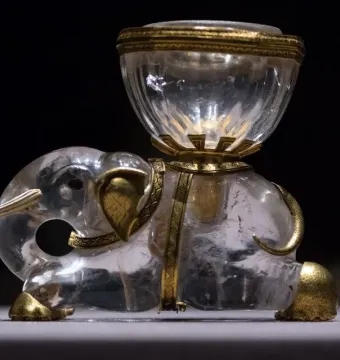
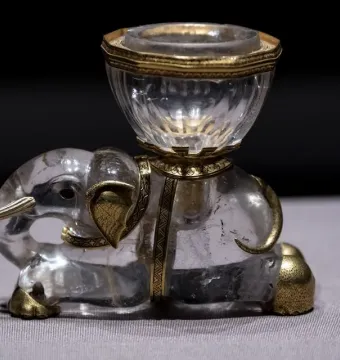
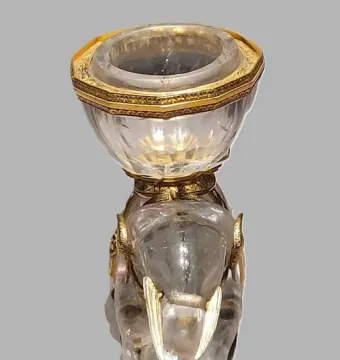
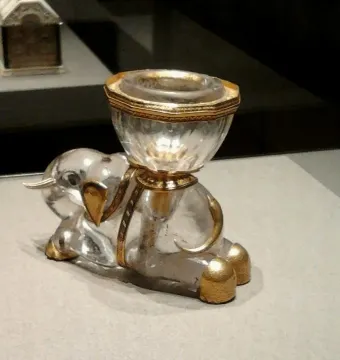
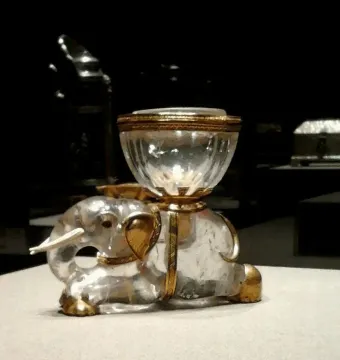
Elephant with Salt Cellar is a mountain crystal elephant, originally made in India in the 15th century. The animal lies stretched out, as if resting under a heavy burden. It was first created without the basket-like fitting that later served as a salt cellar. In about 1550, the Lisbon jeweler Francisco Lopez added this mount for Catherine of Austria, Queen of Portugal, who owned the piece. She later gave it to her daughter-in-law Juana. How it eventually reached Vienna is unknown, though it was probably acquired for Emperor Rudolf II’s collection in Prague. The object is now preserved in the Kunstkammer of the Kunsthistorisches Museum in Vienna, inventory number KK 2320.
June 2016 © Manfred Werner (Tsui) · CC BY-SA 4.0
June 2016 © Manfred Werner (Tsui) · CC BY-SA 4.0
February 2025 © Tizianrot · CC BY-SA 4.0
© Francisco López · CC0
© Francisco López · CC0
Identification | |
| Title | Elephant with salt cellar |
| Type | Composite Kunstkammer object: an elephant sculpture with a salt cellar on its back |
| Original language title | Слон із сільничкою; also given as "Слон с солонкой" and Elefant mit Salzfass |
Historical context | |
| Date of manufacture | 15th century |
| Origin | Made in India; possibly the elephant figure itself was from Southeast Asia |
Creator | |
| Maker / mounting jeweler | Francisco Lopez, goldsmith |
| Date of mounting / assembly | around 1550 |
Discovery and provenance | |
| First recorded mention | In the 1750 inventory of the Vienna Treasury |
| Trade context | Crystal objects with gemstone settings were especially traded in Sri Lanka (then Ceylon) |
| Archive source | Patent letter of 30 September 1550 in the National Archive, Lisbon |
| Commissioning and purchase | The object was bought in 1550 from Francisco Lopez's workshop in Lisbon and probably mounted by him there |
| Possible later acquisition | Probably acquired by Emperor Rudolf II for his Kunstkammer in Prague |
| Later provenance | It later remained in Habsburg possession; how it came to Vienna and its transport, storage, and use are not reconstructed |
| Earlier owner / recipient | Catherine of Castile gave it to her daughter-in-law Joanna of Spain (also described as Joanna, her niece) in 1553 for her wedding |
| Uncertain earlier function | It is unclear whether the back structure may originally have held a noble rider instead of the salt cellar |
| Patron / owner | Catherine of Castile, Queen of Portugal (also described as Catherine of Austria) |
| Alternative origin hypothesis | Another interpretation holds that the crystal elephant may originally have been a perfume flask from Islamic cultural circles, possibly brought from the Sultanate of Deccan to Lisbon |
Physical characteristics | |
| Iconography / interpretation | The elephant is shown as a cultivated, service-bearing pack animal; the motif was associated with royal power and dignity in India |
| Description | A recumbent elephant stretched out as if resting under a heavy burden; head slightly turned left, all four legs extended |
Materials | |
| Salt cellar material | Rock crystal |
| Salt cellar date | 14th century, earlier than the elephant figure |
| Additional materials | Gold tusks, gilded feet, ears, and tail, enameled gold necklace, gold saddle and lip, silver fittings, hyacinths (zircon crystals) in the eye sockets, green and pink enamel on the lid and earlier salt cellar |
| Main material | Rock crystal |
Technique | |
| Manufacture and assembly | Assembled from two treasure objects of different origins; the elephant was made without the basket-like attachment, which was added later as a salt cellar |
| Salt cellar technique | Highly technically accomplished faceted cutting |
Appearance | |
| Structural features | A polygonal salt cellar with a gold lip appears to sit on a gold saddle held by a strap; the lid is lost |
| Detail | The lid was reportedly shaped as a rose blossom with green and pink enamel |
Location and ownership | |
| Current location | Kunstkammer, Kunsthistorisches Museum, Vienna |
| Inventory number | KK 2320 |
History and restoration | |
| Historical context | Catherine of Castile collected exotic luxury objects from Asia, which were accessible to her after Portuguese expansion in India; the object reflects Lisbon's role as a major transshipment center during the Portuguese expansion under João III and Catherine of Castile |
Significance | |
| Significance | One of the oldest holdings in the Habsburg imperial collections; a unique testimony to early modern cultural transfer across continents and to the interplay of the foreign and the familiar |