
Pediments of the Parthenon
The Pediments of the Parthenon are two groups of around fifty statues in Pentelic marble that once stood on the east and west facades of the Parthenon on the Acropolis of Athens. They were probably made by several artists, including Agoracritos, under the direction of Phidias, and were likely in place by 432 BC. Pausanias described their subjects as the birth of Athena on the east and her quarrel with Poseidon on the west. Over time, the sculptures suffered damage from disasters, conflict, weathering, and pollution. Some figures were repaired or replaced during the temple’s long use. Several statues were removed in the early nineteenth century and are now in the British Museum, while others and many fragments remain in the Acropolis Museum in Athens.
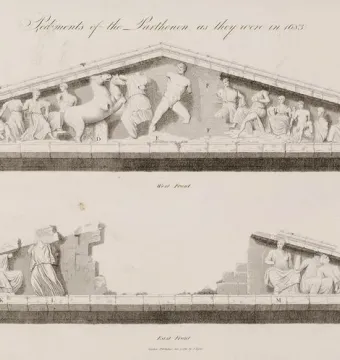
1794 © James Stuart · Public domain
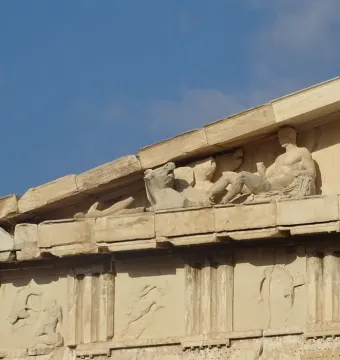
July 2019 © Ad Meskens · CC BY-SA 4.0
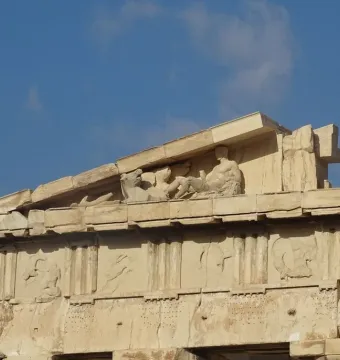
July 2019 © Ad Meskens · CC BY-SA 4.0
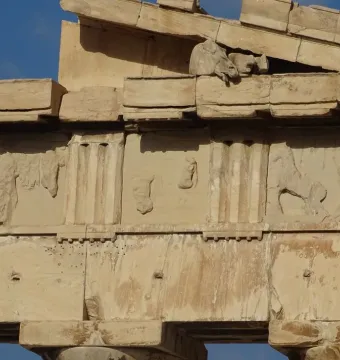
July 2019 © Ad Meskens · CC BY-SA 4.0
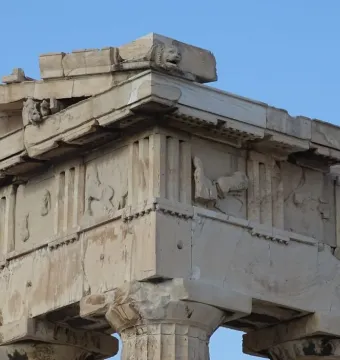
July 2019 © Ad Meskens · CC BY-SA 4.0
Identification | |
| Title | Pediments of the Parthenon |
| Number of pediments | Two: east pediment and west pediment |
| Approximate number of statues | Around fifty |
| Type | Two sculptural pedimental groups |
Historical context | |
| Period | Classical Greece |
| Date | 447–432 BC |
| Historical setting | The Parthenon was built on the Acropolis after the Persian sack of Athens and within the Delian League building program funded from the league treasury moved to Athens in 454 BC |
| Function | Decorative sculpture for the Parthenon, a Doric temple dedicated to Athena and intended as a treasury for the statue of Athena Parthenos |
| Architectural order | Doric |
| Decoration program | The Parthenon also had 92 sculpted metopes and an Ionic frieze around the sekos |
Creator | |
| Master builder | Phidias, probably the master responsible for the work |
| Artists | Several artists worked on the pediments, including Agoracritos |
| Ancient authorship note | Pausanias gives no information on the author of the pediments |
Discovery and provenance | |
| Removal | Several statues were removed by Lord Elgin's agents at the beginning of the 19th century |
| Museum display | From 1816 the removed marbles were exhibited in the British Museum |
| Marble extraction began | 439–438 BC |
| Installation date | Probably 432 BC, near the end of the Parthenon's construction, before the roof was installed |
| Work began | The following year after marble extraction began |
| Marble source | Quarries of Mount Pentelikon |
| Original location | East and west facades of the Parthenon on the Acropolis of Athens, Athens, Greece |
Location and ownership | |
| Current location | Surviving statues and fragments are divided mainly between the Acropolis Museum in Athens and the British Museum in London; some fragments remain in situ on the Parthenon |
| Related building | The Parthenon |
| Monument location | Acropolis of Athens, Athens, Greece |
Physical characteristics | |
| Material | Pentelic marble |
| Overall size | The pediments were about 28.35 m long, about 3.43–3.47 m high at the center, and 0.90 m deep |
| Architectural setting | Installed above the Doric frieze of triglyphs and metopes, beneath a projecting marble cornice topped by a painted sima |
| Support and mounting | All statues were mounted on the horizontal cornice, either on a plinth or on a laying bed, with dowels, spikes, and in the heaviest cases iron props |
Technique | |
| Finishing | The front and back were carefully finished, though some hidden details were left unfinished on certain statues |
| Installation features | Some statues were inclined outward for visibility, and statue G required the cornice to be cut out for installation |
| Mounting mechanism | Deep rectangular grooves at the pediment corners may indicate a lift-type mechanism for mounting statues |
| Sculpture technique | Sculpted in the round; almost all figures were carved in one piece |
| Creation method | The statues were carved on the ground before being lifted into place |
Appearance | |
| Visibility treatment | The figures were arranged to be readable from below, with projecting feet, outward inclinations, and rearing horses filling the space |
| General style | Traditional in form but unprecedented in scale; the western pediment is generally more refined and mannered than the eastern |
| Stylistic note | The west pediment uses symmetry, central tension, and calmer outer figures; the east pediment is notable for especially high-quality drapery and large heavy figures near the center |
Iconography and meaning | |
| West pediment composition | Athena and Poseidon occupy the center, with chariots, messenger gods, and regional mythological figures arranged symmetrically around them |
| West pediment outer figures | The outer figures are usually interpreted as river deities and other Attic mythological figures; some identifications remain uncertain |
| East pediment outer figures | The outer figures appear to be spectators to Athena's birth, including deities and possibly the Moirai |
| Ancient literary source | Pausanias described the general themes of the pediments; this is the only ancient literary account mentioned here |
| West pediment subject | The contest between Athena and Poseidon for Attica/Athens, ending with Athena's victory and the olive tree |
| East pediment subject | The birth of Athena |
| East pediment composition | Zeus enthroned at the center, with surrounding gods and the birth of Athena unfolding outward to the sides |
History and restoration | |
| Documentation | Jacques Carrey drawings survive for parts of both pediments |
| Remaining in situ fragments | One figure and the heads of some horses remain in Athens on the east pediment, and two figures remain on the west pediment |
| Condition | Heavily damaged over time by natural disasters, fire, religious conflict, weathering, pollution, and military conflict |
| Historical transformation | The Parthenon was transformed into a church in the 7th or 8th century, and the east pediment disappeared early in that process |
| Later alterations | Some figures were probably repaired, modified, or replaced during the nearly 1,000 years the temple was in use |
Significance | |
| Art historical significance | Considered an archetype of classical sculpture and an embodiment of ideal beauty |
| Size significance | These are the largest pediment statues made in classical Greece |
| Comparative influence | The pediments of the Temple of Zeus at Olympia appear to have strongly influenced the Parthenon pediments |
| Scholarly note | Bernard Ashmole questioned whether contemporaries could identify all the figures because of the number of statues and the specificity of the myths |