
Ludovisi Ares
Ludovisi Ares is the historiographical name for a 156 cm marble sculpture preserved in the Museo Nazionale Romano, Palazzo Altemps, in Rome. It is usually dated to the Roman period and considered a copy of a late Greek original, attributed to Scopas or Lysippus. Traditionally identified as the god Ares, this interpretation has been questioned, and the figure may instead be Achilles as part of a sculptural group with a Thetis. The beardless nude youth sits on a trophy of weapons, holding a sword by its scabbard while a Cupid or Eros plays with his right leg. Discovered in 1622, the work was later restored by Gian Lorenzo Bernini and became one of the most admired sculptures of the Grand Tour.
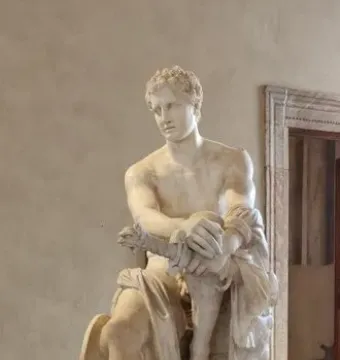
© Lucacorsato · CC BY 4.0
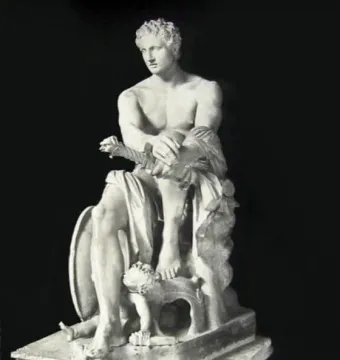
© Carlo Brogi · Public domain
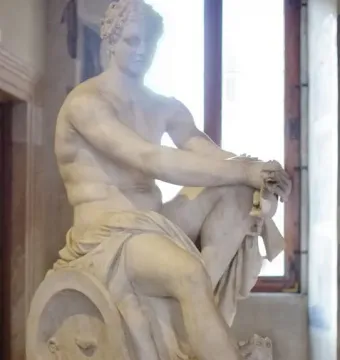
October 2023 © Paolo Villa · CC BY-SA 4.0
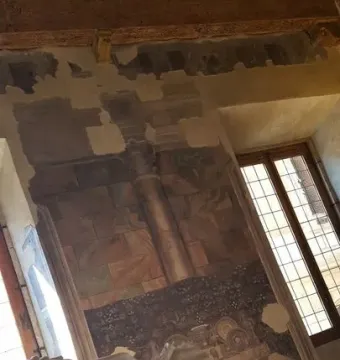
April 2017 © MumblerJamie · CC BY-SA 2.0
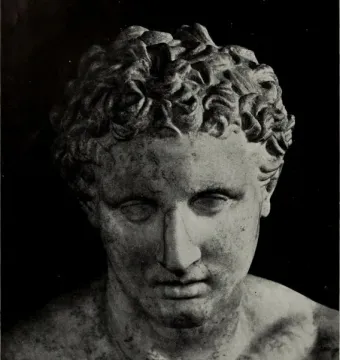
1915 © Internet Archive Book Images · No restrictions
Identification | |
| Type | Ancient Roman marble sculpture |
| Title | Ludovisi Ares |
Historical context | |
| Date | Antonine period; a 2nd-century Roman copy of a late 4th-century BCE Greek original |
| Original Greek model | Lost Greek original, attributed to Scopas or Lysippus |
| Possible interpretation of original | Possibly a Hellenistic reinterpretation of a colossal bronze Ares by Scopas |
Creator | |
| Possible attribution in caption | The head may be a work of the circle of Lysippus, c. 330 BC |
Materials | |
| Material | Marble |
Physical characteristics | |
| Height | 156 cm |
| Size | Life-size |
Iconography and meaning | |
| Interpretation | Traditionally understood as Ares/Mars at rest and as an object of love, with the Eros suggesting a connection to Aphrodite |
| Subject | Ares (Mars), the Greek/Roman god of war |
| Alternative group composition | The statue may originally have belonged to a larger group; possible associated figures include Aphrodite or a second Eros |
| Alternative identification | Possibly Achilles, if it belonged to a sculptural group with a Thetis of the same period |
Appearance | |
| Depicted figure | A young, beardless male figure |
| Associated figure | A small Eros at his feet, looking up at him |
| Attributes | Holds a sword in its scabbard; wears a garment wrapped around the hips and over the left forearm; genitals uncovered |
| Pose | Seated on a trophy of arms; left foot resting on a helmet; shield leaning at his right side |
Discovery and provenance | |
| Auction and dispersal | In 1901 Prince Boncompagni-Ludovisi auctioned the Ludovisi antiquities; the Italian state bought 96 items, and the rest were dispersed among museums in Europe and the United States |
| Collection | Ludovisi collection at Villa Ludovisi and gardens near Porta Pinciana, Rome |
| Villa site | Built on the site of the villas of Julius Caesar and Octavian Augustus |
| Findspot | Near San Salvatore in Campo, apparently near Palazzo Santa Croce in Rione Campitelli, Rome; the exact findspot remains unclear |
| Acquired by | Cardinal Ludovico Ludovisi (1595–1632), nephew of Pope Gregory XV |
| Ancient provenance | Probably part of the Temple of Mars founded in 132 BC by Decimus Junius Brutus Callaicus, in the southern Campus Martius / Campo Marzio |
| Discovery circumstances | Found during drainage or sewage excavation |
| Discovered | 1622 |
History and restoration | |
| Restored by | Young Gian Lorenzo Bernini |
| Restoration work | Bernini refined/polished the surface, added the right foot, and likely added the sword hilt, right hand, right leg, two fingers of the left hand, and the Cupid figure |
| Evidence for Cupid restoration | The Cupid is absent from Susini's bronze replica and from early engravings/prints in Maffei's anthology |
| Bronze replica | A small bronze replica was made by Gian Francesco (G. F.) Susini in the 1630s, during his stay in Rome, and is now in the Ashmolean Museum, Oxford |
| Other reproductions | Natural-size plaster casts were sent to various collections in Europe; engravings were also made and widely circulated, including Francesco Piranesi's 1783 engraving at Villa Ludovisi |
Significance | |
| Reception | The sculpture caused a sensation and had an exceptional reception, especially in the 17th and 18th centuries |
| Grand Tour significance | Considered an essential work for Grand Tour travelers and one of the obligatory sights |
| Art-historical influence | Widely imitated and influential for generations of Neoclassical and academic art students |
| Winckelmann assessment | Johann Joachim Winckelmann called it the most beautiful surviving Mars from antiquity |
| Modern use | Used as the emblem of the Greek athletic club Aris Thessaloniki |
Location and ownership | |
| Current location | National Roman Museum, Palazzo Altemps, Rome |
| Relocation date | 1990 |