
Ludovisi Dionysus
Ludovisi Dionysus is a marble statue of the Greek god Dionysus, now kept in Palazzo Altemps in Rome. It is a Roman work from the 2nd century CE, discovered in the 16th century on the Quirinal Hill during excavation for the foundations of Palazzo Mattei. The sculpture later entered the Ludovisi collection and was displayed at Palazzo Grande and, around 1641, in the sculpture gallery at Casino Capponi. By 1885 it had been moved to Palazzo del Principe di Piombino on Via Veneto. The ivy-crowned Dionysus is shown with a panther and a smaller satyr, and holds a bunch of grapes in his left hand. Several parts, including the satyr’s arms and the lower legs and base, are 16th-century restorations.
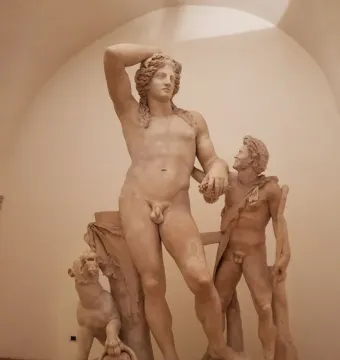
December 2018 © MumblerJamie · CC BY-SA 2.0
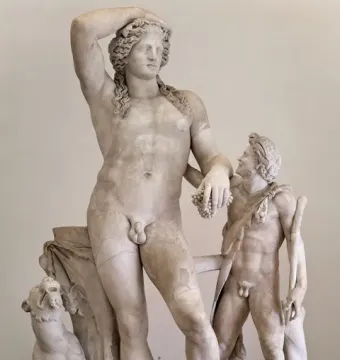
November 2024 © Fabrizio Garrisi · CC0
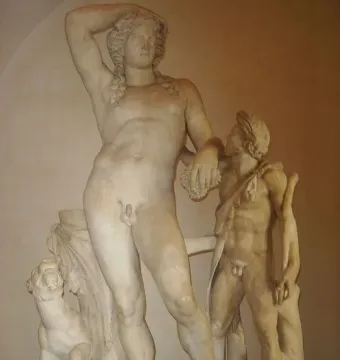
· Public domain
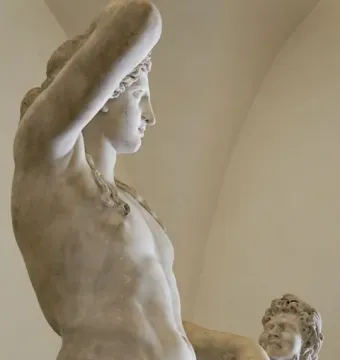
· CC BY 2.5
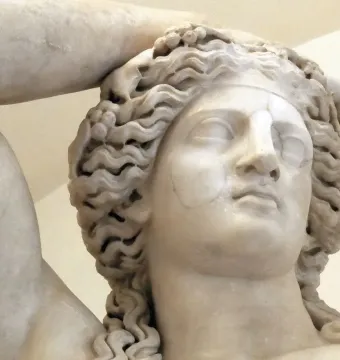
November 2014 © MM · CC BY-SA 4.0
Identification | |
| Title | Ludovisi Dionysus |
| Alternative names | Dionysus with a panther and a satyr; Bacchus Ludovisi; Dionysus, panther and satyr |
| Type | Over-lifesize marble statue |
| Subject | Dionysus, accompanied by a panther and a small satyr |
Historical context | |
| Date | Roman work of the 2nd century AD |
| Original work | Possibly based on a Greek original of the 4th century BC |
Creator | |
| Model or inspiration | Possibly inspired by Apollo Lykeios |
Physical characteristics | |
| Pose | Exaggerated contrapposto, with the god's right hand resting on his head |
| Hair | Long locks fall in a girlish, effeminate way over the shoulders |
| Scale | The satyr is of reduced size |
Materials | |
| Material | Marble |
Iconography and meaning | |
| Symbolism | The panther signals Dionysus's divine presence; the grapes emphasize his status as the god of wine |
| Attributes | Ivy wreath and a bunch of grapes in the left hand |
Location and ownership | |
| Current location | Palazzo Altemps, Rome, National Roman Museum |
Discovery and provenance | |
| Find spot | Quirinal Hill, Rome |
| Discovery context | Found in the 16th century during excavation of the foundations for Palazzo Mattei at Quattro Fontane |
| Original collection | Ludovisi collection |
| Early display location | In front of the Palazzo Grande, the main building of Villa Ludovisi |
| Later display location | In 1641, in the sculpture gallery of the Casino Capponi in the grounds of Villa Ludovisi |
| Later location | New Palazzo del Principe di Piombino, near Via Veneto, by 1885 |
| Acquisition by Rome | Purchased by the City of Rome in 1901 |
History and restoration | |
| Original parts | The heads, torsos, and thighs of Dionysus and the satyr |
| Restored parts | The satyr's arms, the lower legs, and the base are 16th-century restorations |
Significance | |
| Collection history | Part of the Boncompagni-Ludovisi collection, which was open to the public on Sundays and described in guidebooks |
| Historical note | The sculpture became famous while in the Ludovisi collection; the collection was dispersed at the end of the 19th century when the villa grounds were built over |