
Krumlov Madonna
The Krumlov Madonna is a polychrome late Gothic limestone sculpture of the Virgin and Child, 112 cm high, created by an unknown Bohemian master in the late 14th century. It was made at the Prague court under Charles IV, an important cultural center for Gothic artists. First mentioned in 1400, it was later kept in the chapel of Krumlov Castle. Rediscovered in a private house in Český Krumlov in 1910, it was eventually purchased by the Austrian state and has been on display in the Kunsthistorisches Museum in Vienna since 1922, in Room 36 since 2013. The sculpture is a renowned example of the “beautiful Madonnas” style and is noted for its elegant, gently unstable composition and refined late Gothic expression.
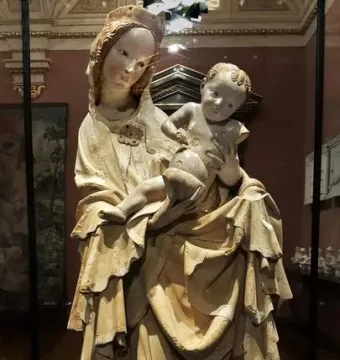
August 2015 © Ondraness · CC BY-SA 4.0
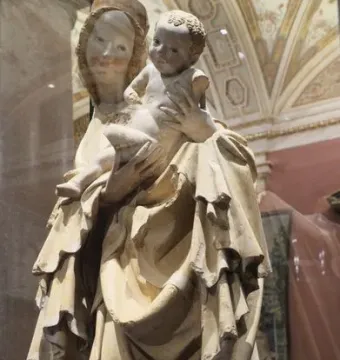
March 2024 © GFreihalter · CC BY-SA 4.0
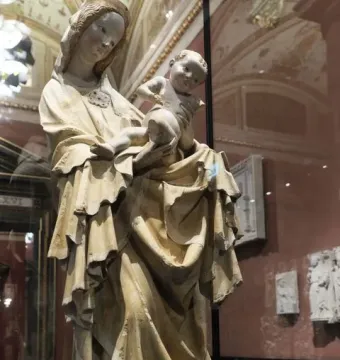
March 2024 © GFreihalter · CC BY-SA 4.0
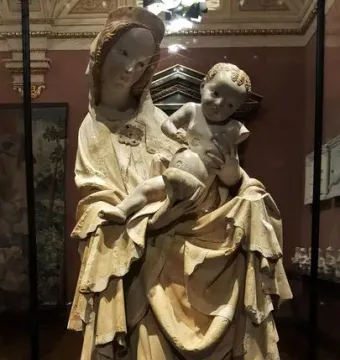
August 2015 © Ondraness · CC BY-SA 4.0
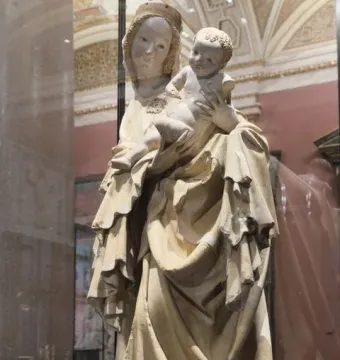
March 2024 © GFreihalter · CC BY-SA 4.0
Identification | |
| Title | Krumlov Madonna |
| Alternative names | Beautiful Madonna of Český Krumlov; Krumauer Madonna |
| Type | Polychrome late Gothic stone sculpture |
| Original title | Krumlovská madona |
| Name origin | Named after Český Krumlov, where it was found and where it was located until 1913 |
Iconography and meaning | |
| Symbolism | The apple alludes to the forbidden fruit in Genesis and has a Marian-Christian soteriological meaning, foreshadowing Christ's sacrifice and the redemption of humanity from sin |
| Iconography | Mary with the Child Jesus |
| Child's attribute | An apple held in the Child's right hand |
| Theological interpretation | Jesus as the new Adam and Mary as the new Eve |
| Subject | Virgin Mary with the Child Jesus |
Materials | |
| Surface and polychromy | Originally polychromed; remnants of paint survive, mainly in white and gold tones |
| Material | Limestone |
Physical characteristics | |
| Height | 112 cm |
| Form | Fully three-dimensional free-standing figure |
Creator | |
| Artist | Anonymous Bohemian master, usually identified as the Master of the Beautiful Madonna of Český Krumlov |
Historical context | |
| Stylistic classification | Beautiful Style; Czech 'style of beautiful madonnas'; southeastern variant of International Gothic / Soft Style |
| Courtly context | Closely linked to court art and court culture around 1400 |
| Artistic genre | Beautiful Madonnas |
| Stylistic period | Gothic |
| Comparative context | The style was cultivated at other European courts and cities, including Milan, Vienna, Paris, Cologne, Salzburg, and Prague-related centers in Bohemia, Moravia, Silesia, and Prussia |
| Date created | Late 14th century, about 1390–1400 |
| Place of creation | Prague court / milieu of the Prague court |
| Historical context of creation | Created in the cultural milieu of the Prague court under Emperor Charles IV, a major center attracting Gothic and International Gothic masters from across the empire |
Discovery and provenance | |
| First recorded location | Chapel of Český Krumlov Castle |
| Acquisition by the Austrian state | Purchased by the Austrian state in 1913 for 30,000 crowns after negotiations with the owner |
| Provenance before discovery | Probably kept in the private residence since 1803, after the dissolution of Zlatá Koruna Monastery in 1785 |
| Discovery | Found in 1910 in a private residence in Český Krumlov |
| Probable original location context | These proposed sites would have matched the sculpture's high artistic quality and exclusive material and suited its status in Český Krumlov, then the main residence of the Rožmberk family |
| Original location uncertainty | The exact original location is unknown and debated; proposed sites include the Franciscan monastery, the local parish church, and the former castle chapel |
| First recorded mention | 1400 |
Location and ownership | |
| Display since | 1922, in Room 36 since 2013 |
| Current location | Kunsthistorisches Museum, Vienna, Austria |
| Current display location | Room 36 of the Kunsthistorisches Museum, in the Kunstkammer |
Significance | |
| Provenance debate | Its artistic provenance and the main centers of production were long disputed in earlier art-historical literature; Prague is now generally accepted as the most important center |
| Cultural significance | Evidence of the cross-border circulation of artistic ideas in Central European Gothic |
| Notability | The best-known sculpture in the Czech 'style of beautiful madonnas' |
| Art-historical significance | One of the most outstanding and valuable examples of the Beautiful Madonna type and of late Gothic Marian sculpture; regarded as a leading example of the Beautiful Style around 1400 |
Appearance | |
| Condition | Mary is better preserved than the Child; the Child is much more damaged, with large losses to the limbs |
| Child | The naked infant Jesus is seated on Mary's left arm, looking in the same direction as Mary; he is rather stocky with a rounded belly, plump cheeks, a small chin, a broad forehead, and small eyes and mouth |
| Brooch | An ornamental fragmentarily gilded quatrefoil brooch with five cross-shaped holes |
| Visual character | Graceful, serene, elegant, and idealized, with a combination of tenderness, innocence, melancholy, and a clear, smooth skin surface |
| Composition | Built on diagonal lines and contrasts, with a strong lateral bend and a sense of unstable balance and movement |
| Drapery | The mantle forms deep chiaroscuro folds; the side sections fall in cascades and the lower drapery rises in dynamic diagonal folds |
| Mary's clothing | A tightly fitting dress or tunic at the torso, almost completely covered by a massive mantle |
| Mary's pose | Standing in a classic contrapposto, weight on the right leg with the left leg bent and slightly advanced; head and torso bend in opposite directions |
| Mary | The Virgin Mary is shown as a young, beautiful woman with delicate features, a high forehead, wide-open eyes, a long thin nose, slightly flat cheeks, small lips, delicate curls in her hair, a veil, and a partially preserved crown |
| Preserved parts of the Child | The right leg is preserved but the lower leg is missing; the left arm survives only near the shoulder; the right hand is missing |
Style | |
| Stylistic features | Delicacy, softness, stylization, idealization, refinement, elegant torsion, and carefully rendered drapery with broad rhythmic sweeps |