
Mourning Athena
Mourning Athena is an ancient Greek marble stele with a relief of the goddess Athena, now in the Acropolis Museum in Athens. Carved from Parian marble, it measures 0.54 m high, 0.31 m wide, and 0.05 m thick. The stele is dated to the 460s BCE and was discovered in 1888 during excavations on the Athenian Acropolis. Athena is shown leaning on a spear with her head bowed in thought, looking toward a boundary marker before her. She wears a peplos and a Corinthian helmet, and her bare feet rest in a composition that departs from strict frontal presentation. Traces of blue paint survive on the relief, indicating that the stele was originally painted.
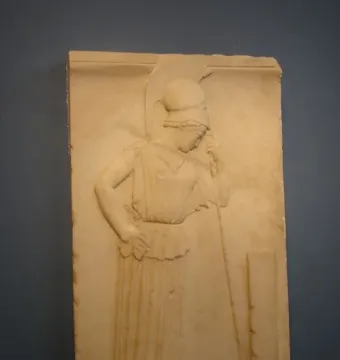
· CC BY-SA 2.5 it
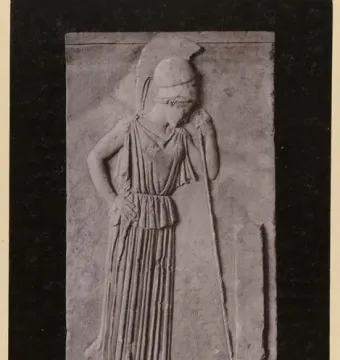
© Rijksmuseum · CC0
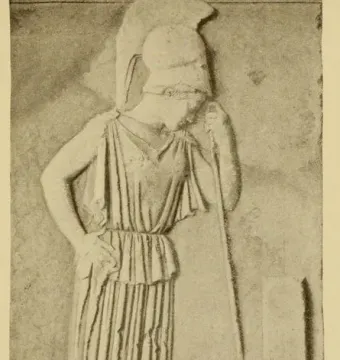
1917 © Internet Archive Book Images · No restrictions
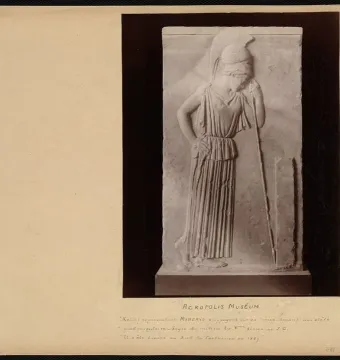
© Boston Public Library · Public domain
June 2023 © Harvey Kneeslapper · CC BY-SA 4.0
Identification | |
| Title | Mourning Athena |
| Alternative titles | Pensive Athena; Athéna contemplative; Athéna pensante; Athéna mélancolique |
| Title in Polish | Atena zadumana |
| Type | Marble relief; stele |
| Subject | Athena |
| Description | A stela/bas-relief depicting Athena in a thoughtful, almost melancholic pose, with a Corinthian helmet and a spear |
| Original French title | L’Athéna pensive |
Historical context | |
| Period | Classical period |
| Style | Severe style |
| Date | c. 460 BC |
| Historical context | Associated with the period of the Persian Wars, which devastated Athens |
Creator | |
| Origin | Athenian |
Discovery and provenance | |
| Related finds from the same excavations | Painted fragments of the Parthenon, statues used as practice by artists before the final works were made, and previously unknown temples |
| Discovery location | Acropolis of Athens, near the Parthenon |
| Condition at discovery | Possibly broken into two pieces |
| Discovery date | 1888 |
Physical characteristics | |
| Height | 0.54 m |
| Width | 0.31 m |
| Thickness | 0.05 m |
| Inventory number | 695 |
Materials | |
| Material | Parian marble |
| Polychromy | Painted; remains of blue paint were found on the relief |
Technique | |
| Technique | Bas-relief |
Appearance | |
| Composition | The figure breaks with frontality, leaves a large amount of empty space, and defines the edge of the composition |
| Associated objects | A stela beside Athena |
| Directional contrast | An oblique spear contrasts with the straight stela and the figure's vertical body and drapery |
| Detail level | Highly detailed, especially in the clothing and hair |
| Pose | Athena leans on a spear with her head lowered, shown in three-quarter view with the face in profile |
| Body orientation | Twisted torso; right leg bears weight and left leg is drawn back |
| Headgear | Corinthian helmet |
| Clothing | Peplos, clasped at the shoulders and cinched at the waist |
| Feet | Barefoot |
Iconography and meaning | |
| Interpretation 2 sub-hypothesis | The offering may have been a thank-you gift from an athlete for a victory |
| Artistic interpretation | The work is controversial and its meaning is debated |
| Interpretation 4 meaning | This would explain Athena's thoughtful, almost melancholic expression, as well as her Corinthian helmet and spear |
| Interpretation 4 | Another hypothesis suggests that the bent-over goddess watches over a list of soldiers killed in combat |
| Interpretation 3 meaning | The pensive Athena would mark the beginning of a list written in columns |
| Interpretation 3 | Athena may be looking at a stela beside her that supported a list of offerings dedicated to her and stored in the Parthenon |
| Interpretation 2 | The bas-relief may be linked to the sanctuary treasure |
| Interpretation 2 meaning | It could have been an offering to the goddess |
| Interpretation 1 gesture meaning | Her reflective gaze may have been intended to remind people entering the sacred place to behave respectfully |
| Interpretation 1 meaning | Athena may be looking toward the boundary to watch over those entering or leaving, or to encourage people to enter her sanctuary |
| Interpretation 1 | The stela may have marked the boundary of a sanctuary dedicated to Athena |
| Interpretation of rectangular object | Unclear; variously interpreted as a grave marker, a race-course marker, or a support for an object such as the infant Erichthonius |
| Interpretation of posture | Possibly sadness or pensiveness; alternatively an exhausted Athena; some interpretations see no emotion |
Location and ownership | |
| Current location | Acropolis Museum, Athens |