
Shigir Idol
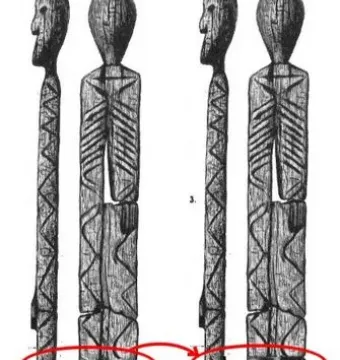
Shigir Idol is a Mesolithic wooden sculpture discovered in January 1890 on the Shigir peat bog, about 100 km from Yekaterinburg in Siberia. It was found broken into several pieces at a depth of 4 meters. The surviving part of the idol is 2.8 meters tall, while the original figure is believed to have stood 5.3 meters high. Carved from fresh larch wood, it has a schematically marked face and a long body decorated with zigzag patterns and seven human face outlines. Radiocarbon dating suggests it is around 10,100 years old, making it the oldest known wooden sculpture in the world. It is currently exhibited at the Sverdlovsk Regional Museum of Local Lore in Yekaterinburg.
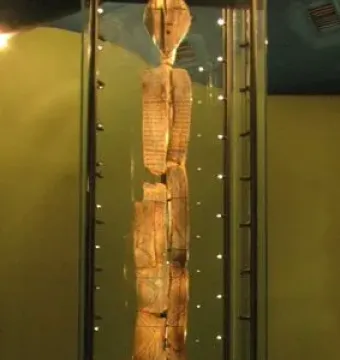
© Владислав Фальшивомонетчик · CC BY-SA 3.0
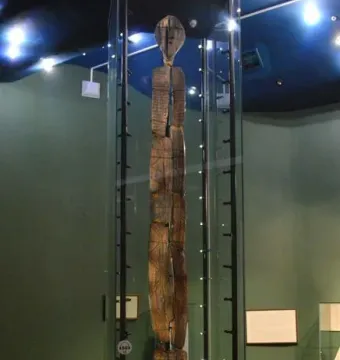
October 2025 © Лапоть · CC0
February 2021 © Леонид Макаров · CC0

February 2021 © Леонид Макаров · CC0
© Beren94 · Public domain
Identification | |
| Title | Shigir Idol |
| Alternative names | Big Shigir Idol; Wooden idol from the Shigir bog; Lidolo di Šigir; L'idole de Shigir; Шигирский идол |
| Type | Wooden sculpture; idol; archaeological monument; decorated wooden post; wooden pole |
Historical context | |
| Cultural period | Mesolithic |
| Date | About 11,500 years old; dated to the 11th millennium BC; earlier estimates ranged from about 9,500 to 11,000 years old |
| Historical context | Made shortly after the end of the last Ice Age; comparable in age to Göbekli Tepe and Nevalı Çori |
Creator | |
| Creator | Unknown |
Discovery and provenance | |
| Discovery date | January 1890; one source gives 24 January 1894 |
| Discovery place | Shigir peat bog, near Kalata (now Kirovgrad), Middle Urals, Russia, about 100 km from Yekaterinburg; one source places the discovery near the modern city of Kirovgrad in the area of the eastern Urals |
| Discovery depth | 4 meters |
| Discovery context | Found in a peat excavation / peat bog, broken into several parts; excavated from the Second Kuryinsky mine / a gold mine |
| Associated finds | More than 3,000 hunting weapons, fishing implements, and tools made of antler, bone, horn, wood, stone, and clay were found at the site |
| Name origin | Named after the locality where it was found |
Physical characteristics | |
| Tree age at felling | About 150-157 years old when cut down |
| Condition at discovery | Found in fragments; badly preserved; entered the museum as a heap of fragments |
| Height | Originally about 5.3 m; preserved height about 2.8 m; later sources give a current height of about 3.4-3.8 m |
Materials | |
| Material | Larch wood |
Technique | |
| Technique | Carved wooden sculpture; decorated with zigzag patterns and outlined human faces |
Appearance | |
| Appearance | Schematically rendered face with eyes, nose, and mouth; long body covered with zigzag patterns and seven outlined human faces |
| Reconstructed form | Lobanov’s reconstruction showed a figure with crossed arms and legs; Tolmachev’s reconstruction showed a three-dimensional head, a board-like body, and a cone-shaped base |
Interpretation | |
| Interpretation | Probably erected as an anthropomorphic pillar deity; possibly served as a ritual pole |
Location and ownership | |
| Current location | Sverdlovsk Regional Museum of Local Lore / Museum of History and Archaeology of the Urals, Yekaterinburg, Russia |
| Display status | Displayed publicly only since 2003; previously kept in a museum storeroom during the Soviet period; one source says it has a separate exhibition dedicated to it |
History and restoration | |
| Excavation and reconstruction history | Reported in 1879; surveyed in 1880; removed from the peat in parts; first reconstructed by Dmitry I. Lobanov, who combined the fragments and produced a 2.8 m reconstruction; in 1914 Vladimir Tolmachev proposed an alternative reconstruction using all fragments and a 5.3 m height |
| Later loss of fragments | The lower fragments / lower half of the body later disappeared for unknown reasons; they are known only from engravings / Tolmachev's drawings |
| Research history | Scientific results were first published in 2018 and corrected in 2021; the area had been investigated since the mid-19th century because of prehistoric finds |
Significance | |
| Significance | Described as the world's oldest surviving wooden sculpture; evidence of Mesolithic wood carving and monumental art |
| Interpretive significance | Finds such as this suggest that the spiritual world and art of hunter-gatherers at the Pleistocene-Holocene boundary were richer and more complex than previously thought; the piece also suggests the importance of Eastern Europe for Stone Age development in Eurasia was underestimated |
Other | |
| Relative age | About twice as old as Egypt's Great Pyramid |
| Research questions and context | Used in research on postglacial development in the mid-Trans-Urals, the cultural sequence of the region, and when the first pottery appeared in the Urals; linked to early rounded-bottom, partly decorated hunter-gatherer pottery and the forest Neolithic, which spread to southern Scandinavia, northern Germany, and the Netherlands |