
Sarcophagus of the Spouses
Sarcophagus of the Spouses is an anthropomorphic terracotta sarcophagus from the late 6th century BCE and a remarkable work of Etruscan art. It was discovered in 1881 during excavations in the Banditaccia necropolis in Cerveteri, ancient Caere, and is now in the National Etruscan Museum in Rome. Made around 530–520 BCE from four separately molded and fired parts, it measures 1.14 m by 1.9 m. The sculpture shows a married couple reclining together at a banquet in the afterlife, with the husband embracing his wife. Its smiling faces, almond-shaped eyes, and elongated braided hair are typical of Etruscan sculpture, as is the emphasis on expressive upper bodies. Traces of paint show that it was originally brightly colored.
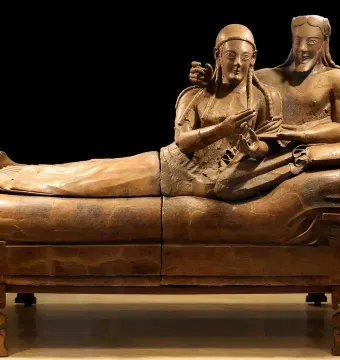
September 2017 © Sailko · CC BY-SA 4.0
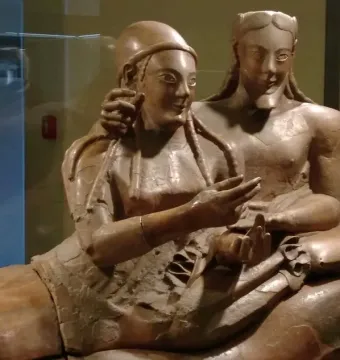
June 2016 © ChristianeB · CC BY-SA 4.0
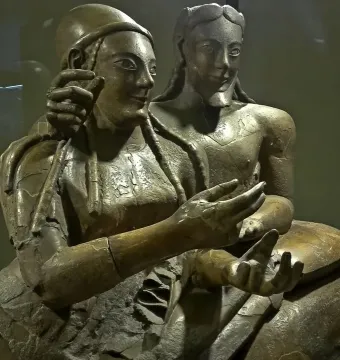
June 2017 © Sara Argiolas · CC BY-SA 4.0
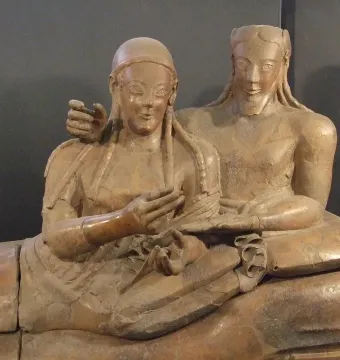
© Frank Axelsson · CC BY-SA 3.0
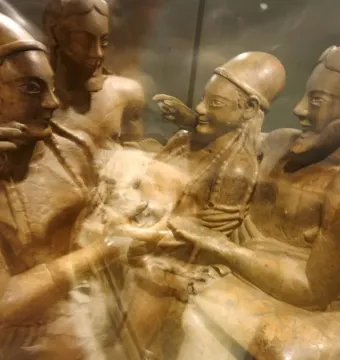
September 2017 © Enzo Trifolelli · CC BY-SA 4.0
Identification | |
| Title | Sarcophagus of the Spouses |
| Original title | Sarcofago degli Sposi |
| Type | Etruscan anthropoid sarcophagus |
Historical context | |
| Culture | Etruscan |
| Date | Late 6th century BCE (ca. 530–520 BCE) |
Discovery and provenance | |
| Findspot | Banditaccia necropolis, Cerveteri (ancient Caere) |
| Discovery date | 1881 |
| Discovered during | Excavations |
| Condition when acquired | Broken into more than 400 fragments |
| Acquired by | Felice Barnabei |
Location and ownership | |
| Related work | A very similar sarcophagus from Cerveteri is in the Louvre Museum, Paris |
| Current location | National Etruscan Museum at Villa Giulia, Rome |
Physical characteristics | |
| Probable contents | Probably contained the ashes of one or both deceased spouses |
| Dimensions | 114 cm high, 190 cm long |
| Figures represented | A man and a woman |
Materials | |
| Material | Terracotta |
Technique | |
| Construction | Made from four separately molded and fired parts |
History and restoration | |
| Original appearance | Painted in antiquity in bright colors; traces of paint survive |
Iconography and meaning | |
| Interpretation | The couple is shown as equal partners and as affectionate spouses in the Etruscan funerary banquet tradition |
| Greek comparison | Feasting couples are compared with Greek vase imagery, but Greek scenes usually show only men |
| Etruscan significance | A husband and wife sharing a banquet couch is a distinctive Etruscan motif |
| Depicted subject | A reclining married couple sharing a banquet in the afterlife |
| Pose | Reclining on a banquet couch (kline) with cushions |
Appearance | |
| Body treatment | Upper bodies are rendered in high relief, while the legs are flattened and schematically treated |
| Composition | The figures face forward rather than toward each other, with emphasis on the upper half of the bodies, especially faces and hands |
| Color and surface | Originally painted; vivid color was part of the design |
| Facial style | Smiling faces with almond-shaped eyes and long braided hair |
| Female figure | Wears a head covering or tutulus, a cloak, and pointed-toed shoes |
| Male figure | Bare-chested, with a cloak or draped lower body, a beard, and his arm around his wife |
Style | |
| Style | Archaic Etruscan style with distorted proportions rather than Greek idealized anatomy |
Significance | |
| Artistic significance | Considered one of the masterpieces of Etruscan art |
Creator | |
| Attribution | Possibly made by the same artist or workshop as the similar Sarcophagus of Cerveteri in the Louvre |