
Usuki Stone Buddhas
Usuki Stone Buddhas are a group of 61 religious statues carved in bas-relief into a tuff cliff in Usuki, Ōita Prefecture, on Japan’s Kyushu island. The site was designated a National Special Historic Site in 1952. In 1962, 59 of the 61 statues were collectively designated an Important Cultural Property, and this was elevated to National Treasure status in 1995. The carvings are classed as magaibutsu, stone Buddhist images cut directly into rock. Most are believed to date from the late Heian period, with some from the Kamakura period, though local legend places their origin much earlier. The site is divided into four groups: Koen, Sannōzan, and two Hoki groups.
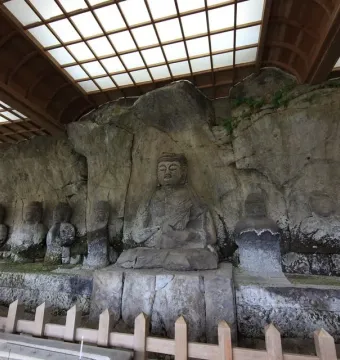
May 2009 © TANAKA Juuyoh · CC BY-SA 3.0
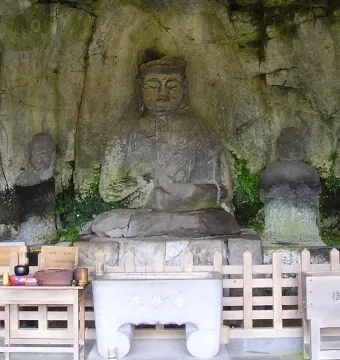
© Si-take. · CC BY-SA 3.0
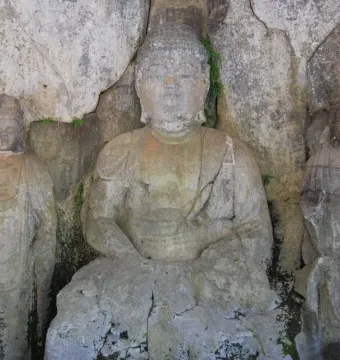
September 2009 © Maarten Heerlien · CC BY 2.0
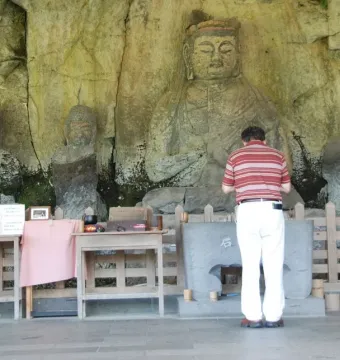
September 2009 © Maarten Heerlien · CC BY 2.0
© Ianb · CC BY-SA 3.0
Identification | |
| Title | Usuki Stone Buddhas |
| Type | group of rock-cut Buddhist statues |
| Number of statues | 61 |
| Grouping | 4 groups |
| Original name | Les 61 Bouddhas en pierre d'Usuki |
Historical context | |
| Date | Unknown; possibly 12th–13th century |
| Historical evidence | No historical materials remain that testify to the period or circumstances of construction |
| Legend | According to the legend of Manano Chōja ('The Legend of Sumiyaki Kogōrō'), the Buddhas were carved by a local magnate to mourn his deceased daughter |
| Legendary date setting | Latter half of the 6th century |
Creator | |
| Artist | Unknown |
Discovery and provenance | |
| Classification | Magaibutsu |
| Locations of groups | Two groups at Hoki, one group at Sannō-zan, and one group at Furuzono |
Physical characteristics | |
| Arrangement | Four groups |
| Material | Tuff |
| Surface treatment | Traces of polychromy are visible |
Technique | |
| Carving technique | Carved in bas-relief |
| Medium | Stone statues carved from tuff formed by pyroclastic flows from Mount Aso |
Location and ownership | |
| Site designation | National Special Historic Site of Japan |
| Cultural property designation | 59 of the 61 statues were collectively designated a National Important Cultural Property in 1962 and elevated to National Treasure status in 1995 |
| Site designation date | 1952 |
| Heritage status | Japanese National Treasure |
| Country | Japan |
| Location relative to station | Approximately 4.5 kilometers southwest of Kami-Usuki Station on the JR Kyushu Nippō Main Line |
| Location | Usuki, Ōita Prefecture, Kyushu, Japan |
| Geographic region | Kyushu |
Significance | |
| Significance | The first National Treasures of Kyūshū, the first stone Buddhas selected as National Treasures, and the only rock-cut statues in Japan to have received National Treasure status |
History and restoration | |
| Reason for restoration | Restoration was demanded by the Ministry of Education as a condition for designation as a National Treasure |
| Current moisture issue | Moss grows in the humid conditions behind the rocks, so measures are being taken to prevent this |
| Drainage improvements | Drainage facilities were introduced around the carvings to prevent water from flowing at the feet or underneath the statues |
| Uncarved wall removed | The portion of wall on which the stone Buddhas were not carved was cut down |
| Topographic change during conservation | The V-shaped valley was destroyed during conservation and restoration work |
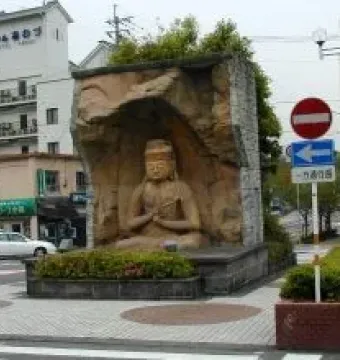
| Replica at Usuki Station | A replica of the Buddha's head on the platform of Usuki Station was made before the restoration and reflects the condition when it was placed underfoot |
| Topography before conservation | The surrounding topography had been a V-shaped valley |
| Restoration debate | There was a fierce debate between restoring the statue to its original state and avoiding drastic changes to a statue that had become a symbol of Usuki |
| Notable restoration case | The Dainichi Nyōrai statue in the Koen Stone Buddha Group had its head remain on a pedestal beneath the body until conservation and restoration were completed in 1993 |
| Condition of heads | Many Buddha heads fell off due to poor conditions |
| Condition of lower bodies | The lower bodies of many statues are missing, as if cut off |
| Erosion damage | Heavy rains turned the worshipers' path into a river that eroded many of the Buddhas |
| Material vulnerability | The tuff is fragile |
| Later history | From the Muromachi period onward, declining Shugendō pilgrimages caused the statues to be forgotten and left exposed to the elements; some may have remained exposed for over 1,000 years |
Appearance | |
| Broad stone-Buddha categories mentioned | Bas-relief images carved directly into a cliff face; movable independent stone Buddhas carved from cut stone; Buddhas carved inside rock caves |
| Koen Stone Buddha Group | Has a total of 13 statues; a Dainichi Nyōrai seated statue in the center; on each side, two Tathāgata statues, two Bodhisattva statues, one Myōō statue, and one Tenbu statue; the specific identities of many statues are uncertain |
| Sannōzan Stone Buddha Group | Consists of three statues: a seated Tathāgata statue in the center and one smaller seated Tathāgata statue on each side |
| Hoki Stone Buddha Group 1 | Divided into four niches; the first and second niches on the left each have three seated Tathāgata statues, and the first niche also has two standing Bodhisattva statues; the third niche is centered on a seated Dainichi Nyōrai statue with one seated Tathāgata statue and one standing Bodhisattva statue on each side; the fourth niche is centered on a Jizō Bodhisattva seated with its left leg down, with statues of the Ten Kings of the Underworld on either side; the third and fourth niches appear to have been added in the Kamakura period; there is also a seated Aizen Myōō statue between the first and second niches |
| Hoki Stone Buddha Group 2 | Consists of two niches; the first niche is centered on a seated Amida Nyorai statue with standing Bodhisattva statues on either side, though there is a theory that the central figure is Miroku Bosatsu; to the left are two Bodhisattva-shaped statues that have remained largely intact; the second niche is centered on nine Amida Nyōrai statues, with a seated statue in the center and four standing Amida Nyōrai statues on each side; there is a standing Bodhisattva statue on each side of these, but the left one does not retain its original shape |
| Depicted Buddha photographed by Ken Domon | Dainichi Nyorai |
Other | |
| Ken Domon photograph source | The photograph appears in his photo collection titled "Pilgrimage in Ancient Temples" |
| Condition at time of photograph | The Buddha's head was lying on the statue's base |
| Photograph date context | The photo was taken before the restoration works of 1980–1993 |