
Donatello's Crucifix of Santa Croce
Donatello's Crucifix of Santa Croce is a polychrome wood sculpture that is usually dated to c. 1406–1408 or 1409–10. If the earlier dating is correct, it would belong to Donatello’s early career, when he was working in Lorenzo Ghiberti’s workshop and beginning to receive independent commissions. The crucifix is now in the Cappella Bardi di Vernio, just off the left transept of Santa Croce in Florence, Italy. Historical sources attribute the work to Donatello, though some art historians have disputed this and proposed other sculptors. It was praised and criticized for its unusual realism, with Brunelleschi reportedly calling it a “contadino” on a cross.
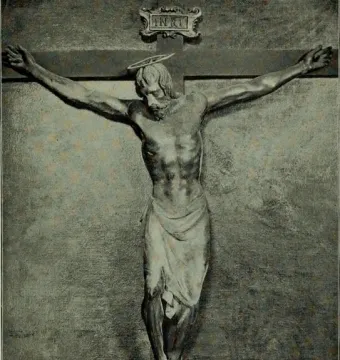
1904 © Internet Archive Book Images · No restrictions
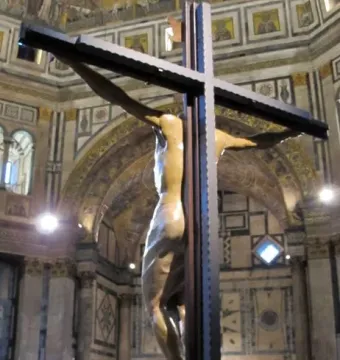
November 2012 © sailko · CC BY-SA 3.0
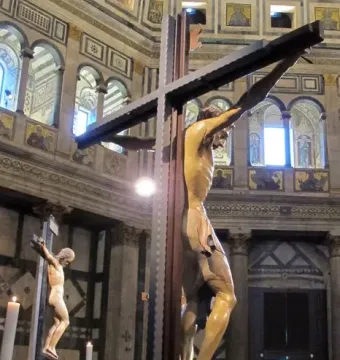
November 2012 © sailko · CC BY-SA 3.0
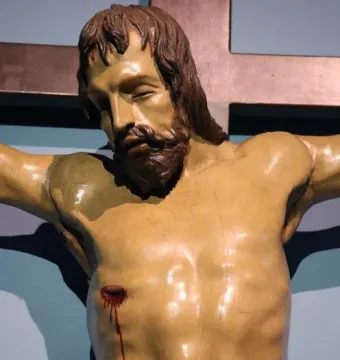
April 2022 © Francesco Bini · CC BY-SA 4.0
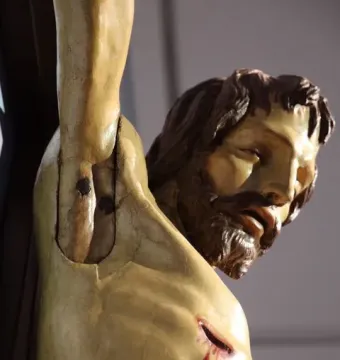
June 2022 © Francesco Bini · CC BY-SA 4.0
Identification | |
| Title | Crucifix of Santa Croce |
| Alternative title | Donatello's Crucifix of Santa Croce; Santa Croce Crucifix |
| Type | Crucifix |
| Subject | Christ crucified |
Creator | |
| Artist | Donatello |
| Attribution | Traditionally attributed to Donatello; the attribution is now generally accepted, though some art historians have proposed other artists |
| Alternative proposed artists | Nanni di Banco; Michelangelo Buonarroti |
Historical context | |
| Date | Probably circa 1406–1408, or 1409–1410 |
| Dating uncertainty | The date is uncertain; if the earlier dating is correct, Donatello was then a young artist working in Lorenzo Ghiberti's workshop and beginning to receive his own commissions |
| Relative chronology | Usually considered earlier than Brunelleschi's Crucifix of Santa Maria Novella by about ten years |
| Cultural context | Florentine Renaissance |
Discovery and provenance | |
| Original location | Barbigia chapel of the Church of Santa Croce, Florence |
| Present location | Bardi di Vernio Chapel, left transept of Santa Croce, Florence, Italy |
| Provenance notes | Moved to its present chapel by 1571; Vasari recorded the transfer in a letter to Matteo Benvenuti dated 29 December 1571 |
| Early source mentions | Mentioned, though not described, by the Anonimo Magliabechiano and in Vasari's Lives of the Artists; first recorded in the Book of Antonio Billi (c. 1515) |
Physical characteristics | |
| Mobility | Movable crucifix |
| Dimensions | 168 × 173 cm |
Materials | |
| Material | Polychrome wood |
Appearance | |
| Style | Highly realistic, with unusual realism and a strong sense of suffering |
| Figure treatment | Contracted features, parted mouth, half-open eyes, articulated shoulders, energetic and vibrant modeling |
| Composition | Ungainly composition that emphasizes distress and physical tension |
Iconography and meaning | |
| Interpretive context | Placed within Savonarola-related devotional thought and late-15th-century sacred performance traditions in some interpretations |
| Liturgical use | Could be taken down from the cross during Holy Week ceremonies; possibly commissioned for Holy Week use |
| Patronage context | Possibly made in response to Franciscan preferences for emotionally affecting images |
| Interpretation | Emphasizes the suffering and human truth of Christ, aiming to move worshippers through compassion |
| Depicted figure | Christ on the cross |
Location and ownership | |
| Current display | Visible in the Bardi di Vernio Chapel |
History and restoration | |
| Scholarly dispute | The identification of this crucifix with the work in the Brunelleschi anecdote is not unanimous |
| Anecdote | According to Billi and Vasari, Filippo Brunelleschi criticized the crucifix as looking like a 'contadino' and then made a response crucifix for Santa Maria Novella |
| Modern scholarly view | Many art historians now doubt Vasari's story and date the two works about a dozen years apart |
| Alternative identifications | Parronchi identified the crucifix in the sources with the Bosco ai Frati crucifix; Johnson identified the Billi, Magliabechiano, and Vasari work with the Bosco ai Frati Monastery crucifix, now generally dated to the second half of the 15th century |
Significance | |
| Art-historical significance | Seen as a contrasting counterpart to Brunelleschi's Crucifix of Santa Maria Novella and as an example of the personal differences between the two masters of the Florentine Renaissance |
| Stylistic significance | Sometimes interpreted as opposing the Hellenizing elegance associated with Lorenzo Ghiberti and the harmonious mathematical composure associated with Brunelleschi |