
Omphalos
Omphalos was a cult stone in the adyton of the Temple of Apollo at Delphi, covered with woolen fillets and revered as the “navel of the world.” According to myth, it fell from heaven as a meteor, though it may originally have been an offering stone of the goddess Gaia. It marked the place where Zeus’s eagles from the east and west met at the center of the world. Pausanias described it as the world axis linking heaven, earth, and the underworld. A Hellenistic or Roman marble copy is now in the Archaeological Museum of Delphi. The term later also referred to the Umbilicus in the Roman Forum and to other symbolic centers.
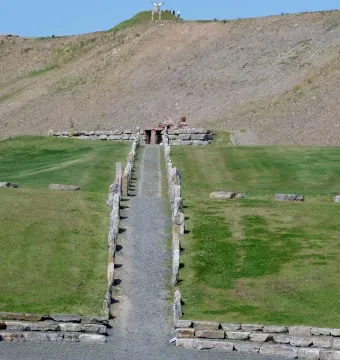
August 2015 © Rosser1954 · CC BY-SA 4.0

August 2015 © Rosser1954 · CC BY-SA 4.0
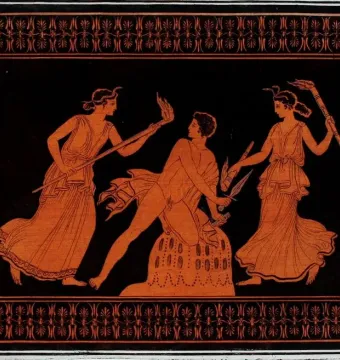
1766 © Internet Archive Book Images · No restrictions
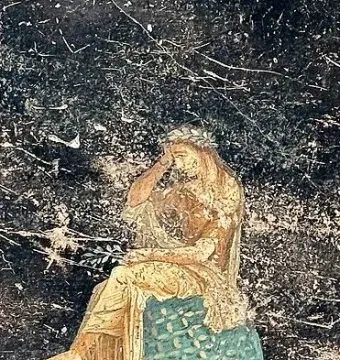
May 2024 © Chappsnet · CC BY-SA 4.0
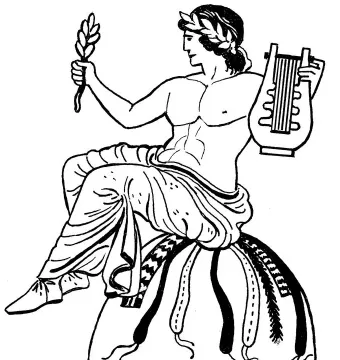
October 2020 © Pearson Scott Foresman · Public domain
Identification | |
| Title | Omphalos |
| Original Greek name | ὀμφαλός (omphalós) |
| Name meaning | Navel; umbilicus |
| Type | Sacred stone (baetyl), a cult object associated with the center of the world |
| Alternative names | Onfalo; Ônfalo; Omfalos; El ónfalo |
Historical context | |
| Associated deity | Apollo |
| Associated temple | Temple of Apollo at Delphi |
| Associated sanctuary | Sanctuary of Apollo at Delphi |
| Associated place | Delphi, Ancient Greece |
| Cultural context | Ancient Greek religion; later Roman tradition and wider comparative religious traditions |
Creator | |
| Artist | Dimitri Hadzi |
| Artist | Lars Vilks |
Discovery and provenance | |
| Former location | Harvard Square, Cambridge, Massachusetts |
| Removal date | 2014 |
| Planned relocation | Rockport, Massachusetts |
| Program | Arts on the Line |
| Former location | Kullaberg nature reserve, Skåne County, Sweden |
| Discovery location | Near the Temple of Apollo during excavations at Delphi |
| Collection date | As of 2001 |
| Current ownership | Belongs to the collections of Moderna Museet in Stockholm, Sweden |
| Copy type | Hellenistic or Roman marble copy |
| Current object | Marble copy of the sacred stone |
| Current copy location | Delphi Archaeological Museum |
| Original location | Adyton of the Temple of Apollo at Delphi |
Physical characteristics | |
| Form | Rounded stone; conical or half-egg-shaped, sometimes described as a monolithic block with a hollow center widening toward the base |
| Decoration | Covered with a knotted wool net or garlands; also described as interwoven cords |
| Associated objects | Sometimes shown with two golden eagles; precious stones carved as Gorgon heads are also mentioned in some descriptions |
Materials | |
| Material | Stone; one copy is marble |
| Material | Concrete and rock |
Technique | |
| Surface treatment | Oiled daily and dressed with fresh wool during celebrations |
Appearance | |
| Visual description | A sacred stone resembling a protruding navel |
| Depiction in art | Apollo was often depicted seated on the omphalos; it is also shown in statues of Apollo and Asklepios |
| Depiction | Shown schematically as a point in the center of a circle on coins |
Iconography and meaning | |
| Religious function | Believed to allow communication with the gods; at Delphi it was part of the oracle context through which the Pythia gave prophecies |
| Interpretive note | The stone of Cronus may be confused with the Omphalos because it was worshipped similarly |
| Roman significance | Regarded by the Romans as the center of the world and the reference point for Roman distance measurements |
| Roman equivalent | Umbilicus on the Forum Romanum |
| Religious association | Originally associated with Gaia/Gea and Python, later transferred to Apollo |
| Later usage | Later used more generally as a word for a center or focal point |
| Associated burials | Some traditions place beneath it the tomb of Dionysus or the tomb of Python |
| Mythological association | Linked to the birth and protection of Zeus and to the swallowing and later disgorging of the stone by Cronus |
| Associated figures | Zeus, Rhea, Cronus, Apollo, Asklepios, Python, Gaia/Gea, Uranus, Metis, Pythia |
| Alternative myth | Another tradition identifies it with the stone Rhea wrapped in cloth and gave to Cronus in place of the infant Zeus |
| Mythic origin | According to legend, Zeus released two eagles from opposite ends of the world; they met at Delphi, where Zeus placed the omphalos as the center of the world |
| Symbolic meaning | Symbol of the navel, center, or cosmic center of the world; a point of contact between the human world, the gods, and the dead |
Location and ownership | |
| Current/known copy status | A Roman copy was kept in the museum created for the discoveries |
| Possible former topping | A statuette of two golden eagles or an Apollo statue may once have surmounted it |
| Column location | Atop an acanthus column at the northeast corner of the sanctuary |
| Placement in sanctuary | Placed in the adyton, the sacred inner part of the temple, near the Pythia |
| Original cult location | Delphi sanctuary |
| Current museum location | Delphi Archaeological Museum |
History and restoration | |
| Historical uncertainty | Its original use and exact form are uncertain, partly because the site was destroyed in the 4th century CE |
| Destruction | The site was destroyed by Theodosius I and Arcadius in the 4th century CE |
Significance | |
| Meaning in antiquity | Regarded by the ancient Greeks as the navel or center of the world and of the cosmos |
| Cultural spread | Comparable traditions occur in many cultures; several omphalos stones were erected across the Mediterranean basin |
| Related traditions | Comparable examples include the Hindu lingam, the Dome of the Rock, and the Kaaba with its Black Stone |
| Astronomical interpretation | Some scholars have suggested a fallen conical meteorite as the origin of the sacred stone, but this remains debated |
| Herodotus interpretation | Herodotus treated Ionia as the center of the world in a climatic and moral sense |
| Modern imitation | Andreas Schlüter imitated the idea with an Omphalos on Berlin Palace Square; the site was later marked by an eight-armed candelabrum by Karl Friedrich Schinkel and in 1891 by the Neptune Fountain by Reinhold Begas |