
Amazon statue types
Amazon statue types refer to a group of Roman marble copies of a wounded Amazon, long discussed in relation to Pliny the Elder’s account of five bronze statues of Amazons in the Artemision of Ephesus. Pliny linked the presence of so many works on the same subject to a fifth-century BC competition among Polyclitus, Phidias, Kresilas, Kydon, and Phradmon. This anecdote led to identifications of four known types with lost originals, probably dating to around 430 BC on stylistic grounds. The Mattei type is widely accepted as deriving from Phidias, while the assignments of the Sciarra and Sosicles types to Polyclitus and Kresilas remain uncertain. Some scholars have questioned the Plinian story altogether and proposed a more cumulative development from fifth-century prototypes, later supplemented by other models.
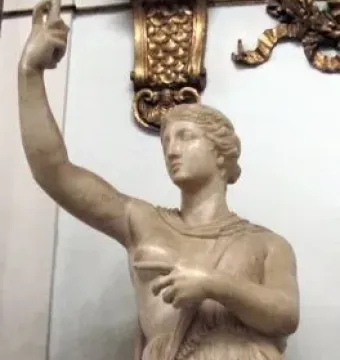
November 2013 © Sailko · CC BY 3.0
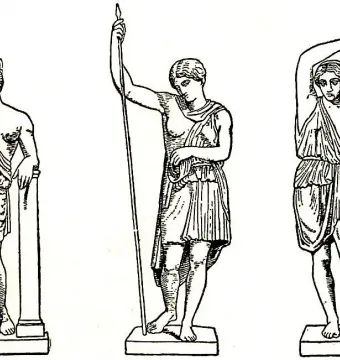
© Left to right: Polyclitus, Cresilas, Pheidias? · Public domain
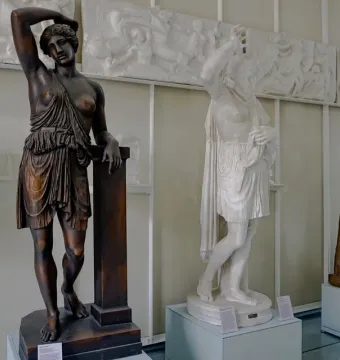
May 2016 © Wuselig · CC BY-SA 4.0
Identification | |
| Title | Amazon statue types |
| Classification | Set of ancient statue types depicting wounded Amazons |
Iconography and meaning | |
| Iconographic comparison | The pose with one arm resting on the head is comparable to Apollo Lykeios |
| Subject | Wounded Amazon |
Historical context | |
| Date | 5th century BC, around 435 BC |
| Commission | Competition to decorate the Temple of Artemis at Ephesus |
| Historical source | Mentioned by Pliny the Elder in Natural History |
| Mattei type date | Augustan era |
| Capitoline type date | Era of Tiberius |
Creator | |
| Mattei type attribution | Usually attributed to Phidias |
| Villa Doria Pamphilj attribution | Attributed by Adolf Furtwängler to the Ephesus group, but C. P. Sestieri identified it as a classicizing Roman work and a representation of Diana; H. von Steuben identified it as an eclectic classicizing work modelled on the Lansdowne Wounded Amazon |
| Capitoline type attribution | Derived from an original by Polyclitus or Kresilas; the attribution is disputed |
| Sosicles copy attribution | Derived from an original by Polyclitus or Kresilas; the attribution is disputed |
| Artists named by Pliny | Polyclitus, Phidias, Cresilas, Cydon, and Phradmon |
| Competition result in Pliny | Polyclitus won; Phidias was second; Cresilas third; Cydon fourth; Phradmon fifth |
Discovery and provenance | |
| Additional variant | Doria-Pamphilj Amazon, usually treated as a variant of the Berlin type and sometimes counted as a fourth type |
| Lansdowne Amazon discovery | Said to have been found in Tor Colombara by Gavin Hamilton |
| Capitoline type discovery | Found in Rome in 1868 in the Gardens of Sallust |
| Mattei type current location | Gallerie delle Statue of the Pio-Clementine Museum, Vatican |
| Mattei type discovery | Discovered in 1770 and formerly in the Mattei collection |
| Original statues recorded by Pliny | Five bronze statues |
| Recorded location of the bronzes | The Artemision of Ephesus |
| Fifth type discovery | Excavated at the theater of Ephesus in 1898 |
| Fifth type publication status | Unpublished |
| Lost originals | The Roman copies are thought to derive from lost originals, possibly dating to around 430 BC on stylistic grounds |
| Known surviving copy types | Four Roman marble copy types are known, each represented by numerous copies and heads |
| Surviving types clearly identified | Three homogeneous groups have clearly survived; a fifth type excavated at the theater of Ephesus in 1898 is unpublished and entered discussion only in the 1950s |
| Lansdowne status | Possible fourth type, probably a variant of the Sciarra type |
| Main surviving types | Berlin type, Mattei type, Capitoline type |
| Capitoline type current location | Ny Carlsberg Glyptotek, Copenhagen |
| Lansdowne Amazon provenance | Later at Lansdowne House |
| Sosicles copy type | Known mainly from a high 2nd-century AD marble copy signed by Sosicles |
| Mattei type other copy | Another copy is in the Capitoline Museum |
| Sosicles copy discovery | Discovered in 1733 |
| Sosicles copy provenance | Went into the collection of Cardinal Giuseppe Albani |
| Sosicles copy current location | Capitoline Museums, Rome, Room 33 |
| Naming convention | Usual designations following Adolf Furtwängler |
| Type names | Lansdowne type, Capitoline type, Mattei type, Villa Doria Pamphilj type, and a fifth type excavated at the theater of Ephesus in 1898 |
| Lansdowne Amazon current location | Metropolitan Museum of Art |
Physical characteristics | |
| Capitoline type pose and attributes | Left arm rests on a column; right hand is behind the head; the face leans to one side |
| Sosicles copy pose and attributes | Left arm across the body below the breasts; right hand raised, open-palmed; looking down toward the wound in the right side; wears a baldric |
| Mattei type pose and attributes | The figure looks down, with the right arm parrying and the left arm by her side, with a quiver under it |
| Shared head type | Similar head and face across the types |
| Common variation in equipment | Some versions are armed rather than wounded |
| Common variation in arm pose | Some versions show the right hand open-palmed or the left arm in front of the chest |
| Common variation in gaze | Some versions look down |
| Common injury | Wounded in the right breast or right side |
| Common pose | Right arm raised above the head; left arm lowered or placed across the body, often supported by a spear or other support |
| General costume | Short chiton or peplos that has fallen from one or both shoulders, leaving the figure bare-breasted |
| General figure type | Standing female figure |
Materials | |
| Other copying practice | Copies were also made as complete statues, busts, or herms, in stone at full size and in bronze miniature |
| Capitoline type material | Marble copy |
| Original material | Bronze |
| Surviving copies | Roman marble copies |
Other | |
| Cydon issue | The name Cydon is problematic because it does not appear in other sources; it may be the ethnicon of Cresilas, meaning he was from Cydonia on Crete |
| Scholarly note on the anecdote | Pliny was aware of discrepancies in the sculptors' dates; many researchers, including E. Hohl, considered the contest story invented, though the statues themselves were real |
| Phradmon identification | No type derived from Phradmon has been identified |
| Alternative scholarly interpretation | Dietrich von Bothmer rejected the Plinian anecdote as an etiological embroidery invented to explain the five varying Amazon statues; Brunilde Sismondo Ridgway proposed a cumulative origin from fifth-century prototypes, later additions by Phradmon, and later classicizing models |
| Interpretive note | R. Bolnach wrote a thorough form analysis for the Sciarra/Polyclitus and Sosicles/Kresilas pairings |
History and restoration | |
| Sosicles copy restorations | Tip of nose, lower lip, left forearm, and hand with drapery are restorations |
| Capitoline type restorations | Nose, right arm from the deltoid downward, left forearm below the elbow, both hands, and the right foot and ankle are restorations |
| Mattei type restorations | Both arms, the head, and the left shoulder are restorations |
| Lansdowne Amazon restorations | Right arm and lower legs are restored |
| Villa Doria Pamphilj condition | Much restored |