
Young Mother in the Grotto
Young Mother in the Grotto, also known as Woman and Love, is a plaster sculpture by Auguste Rodin made around 1885. It was first exhibited at the Salon of Paris in 1885. Rodin had explored the subject earlier, beginning in the 1860s while working for the Sèvres Manufacture, where he was allowed to experiment with the work. The piece reflects Rodin’s interest in maternal love, similar to The Eternal Spring, and it also appears at the lower left of The Gates of Hell. Rodin later created autograph versions in ivory and bronze, modeled after his wife Rose Beuret and their child Auguste-Eugène. The sculpture contrasts rough rock with the softness of the figures’ skin, suggesting a tension between life and death.
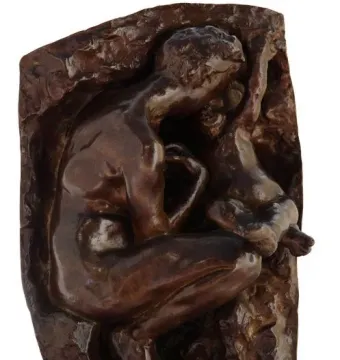
© Auguste Rodin · Public domain
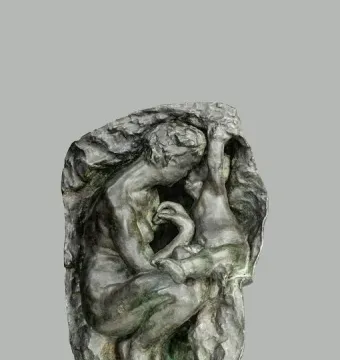
June 2016 © Museo Soumaya · CC BY-SA 4.0
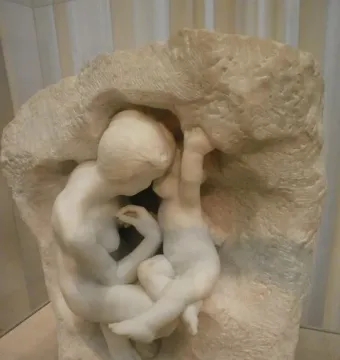
August 2016 © Auguste Rodin · Public domain
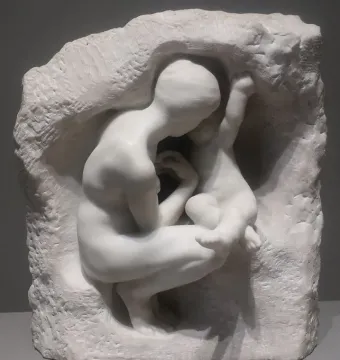
© Hiart · CC0
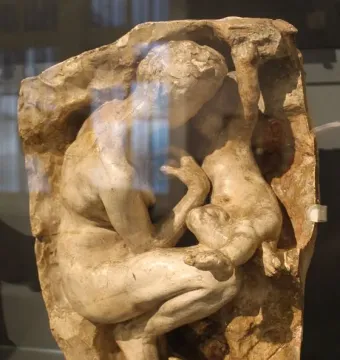
January 2024 © 14GTR · CC0
Identification | |
| Title | Young Mother in the Grotto |
| Alternative title | Woman and Love |
| Title in French | Jeune mère dans la grotte |
| Title in Spanish | Joven madre en la gruta |
| Type | Sculpture |
Creator | |
| Model for autograph versions | Rose Beuret and their child Auguste-Eugène |
| Artist nationality | French |
| Artist | Auguste Rodin |
Historical context | |
| First versions | Made in the 1860s while Rodin was working for the Sèvres Manufacture |
| First exhibition | Paris Salon, 1885 |
| Exhibited under title | Woman and Love |
| Final version date | 1885 |
| Date conceived | circa 1885 |
Discovery and provenance | |
| Made for | Rodin's work for the French porcelain factory Porcelaine de Sèvres |
Materials | |
| Autograph versions materials | Ivory and bronze |
| Material | Plaster |
Physical characteristics | |
| Subject | Woman and child |
Iconography and meaning | |
| Theme | Maternal love |
| Interpretation | The contrast evokes a relationship between life and death |
| Other themes | Mythological themes |
Appearance | |
| Compositional contrast | Soft human figures contrasted with the rough grotto or rock |
| Original display feature | The two groups originally had a roof that plunged them into deeper shadow |
Technique | |
| Artistic influence | Michelangelo |
Location and ownership | |
| Appears in another work | Lower left of The Gates of Hell |
Related works | |
| Related work | The Eternal Springtime |
| Influence on later work | Strongly influenced John Tweed's Mother and Child (1894) |
| Related artist | John Tweed |
| Relationship to artist | Very close to Rodin; they shared studios to house their respective families and were important to each other's artistic creation |