
MacGregor plaque
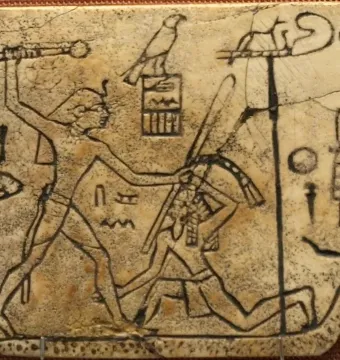
The MacGregor plaque is an ancient Egyptian ivory tablet, probably from the mastaba of Pharaoh Den and dated to around 2985 BC. It is also known as the sandal tag of Den and may have come from the king’s tomb at Abydos. The plaque was acquired by the British Museum in 1922 from the MacGregor collection and is now catalogued as BM EA 55586. Measuring 4.5 by 5.4 cm and about 0.2 cm thick, it is carved ivory with fire-engraved images. One side shows Den in a combat pose, wearing a nemes headdress and the Horus name inscription, while the other shows a pair of sandals, though part of it is badly worn.
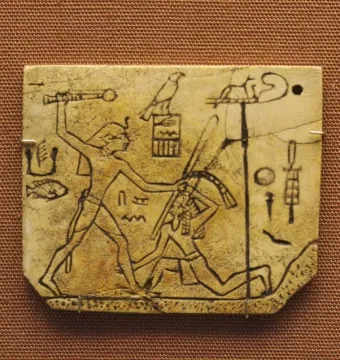
· CC BY-SA 2.0
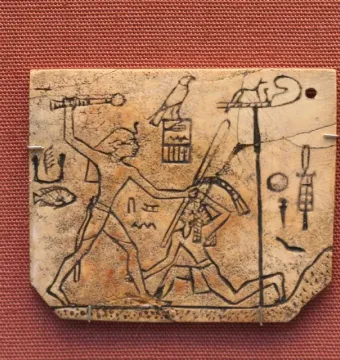
· CC BY-SA 2.0
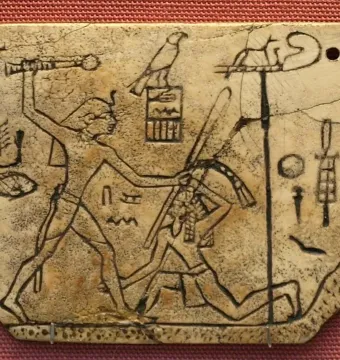
June 2023 © Captmondo · CC BY 2.5
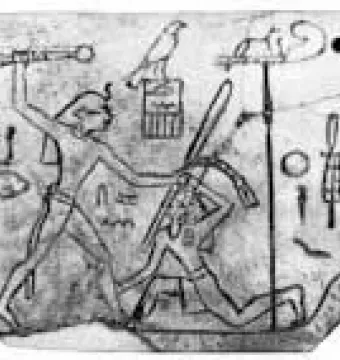
June 2006 © Oesermaatra0069 · Public domain
© CaptMondo · CC BY 2.5
Identification | |
| Title | MacGregor plaque |
| Type | Ivory plaque / tablet |
| Alternative names | Ritual tablet of Pharaoh Den; sandal tag of Pharaoh Den; MacGregor Tablet; King Den's sandal label; MacGregor-Plakette; MacGregor-Täfelchen; Sandalenplakette von König Den; Targhetta MacGregor; Placchetta MacGregor |
Historical context | |
| Culture | Ancient Egyptian |
| Dynasty | First Dynasty of Egypt |
| Date | circa 2985 BCE |
Creator | |
| Associated ruler | Pharaoh Den (Hor Den) |
Discovery and provenance | |
| Inventory number | BM EA 55586; 1922,0728.2 |
| Acquisition by current museum | Acquired by the British Museum in 1922 |
| Former collection | MacGregor collection |
| Excavator | Émile Amélineau |
| Probable findspot | Mastaba tomb of King Den at Abydos |
Physical characteristics | |
| Dimensions | 4.5 cm × 5.4 cm |
| Thickness | about 0.2 cm |
| Weight | 10 g |
Materials | |
| Material | Carved ivory |
Technique | |
| Technique | Engraved and fire-burnt images |
Iconography and meaning | |
| Associated deity standard | Jackal standard of Wepwawet / Upuaut |
| Original function | Originally attached to the king's sandal(s), according to the inscription |
| Reverse condition | Left side badly damaged by abrasion / scratches |
| Reverse depiction | A pair of sandals |
| King's attire | Loincloth with an animal tail, and a khat headdress or archaic nemes with uraeus |
| Inscription on front | Den is identified by his Horus name; text reads 'I was the one who completed the first strike toward the east' |
| Enemy identification | Probably an Asiatic, identified by hairstyle, goatee, and braids |
| Enemy depiction | Kneeling or fallen enemy, trying to ward off the blow |
| King's pose | Right hand raised holding a mace, left hand grasping an enemy by the hair |
| Front depiction | King Den in the smiting-the-enemy motif |
Location and ownership | |
| Current location | British Museum, London |
History and restoration | |
| Provenance note | Probably from the tomb of King Den at Abydos; said to derive from Émile Amélineau's excavations |
| Interpretation of inscription | Taken to mean that King Den personally achieved his first victory against eastern peoples |
| Historical context of inscription | Suggests further battles and possible losses, reflecting early First Dynasty efforts to defend and expand Egypt's frontiers and territories |
| Comparative reference | The Palermo Stone may refer to the same event, but more likely records later campaigns in the second half of Den's reign |
Significance | |
| Historical significance | Among the oldest images of a ruler, together with depictions of Narmer |
| Art-historical significance | Earliest attestation of the khat headdress |
| Royal iconographic significance | Horus Den is the first known king to display the double crown |
Other | |
| Media appearance | Featured in episode 11 of the BBC radio series A History of the World in 100 Objects (2010), a BBC and British Museum collaboration |