
Sarcophagus of the Spouses
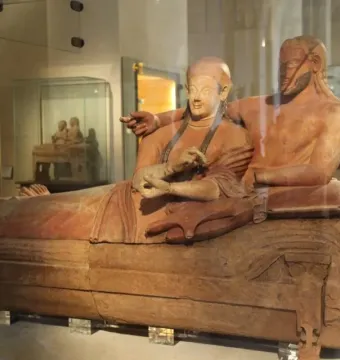
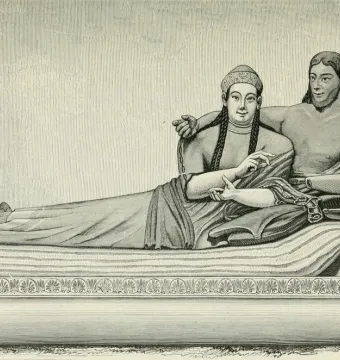
The Sarcophagus of the Spouses, also known as the Sarcophagus of Cerveteri, is a monumental funerary urn and a masterpiece of Etruscan art. Made of terracotta and originally polychrome, it depicts a married couple reclining together in the typical pose of an Etruscan banquet. The work is conserved in Paris at the Louvre Museum. It was restored in a Louvre-Lens workshop and served as the main piece in the exhibition The Etruscans and the Mediterranean, held from 5 December 2013 to 10 April 2014. Its large size is one of its defining features, and the work reflects both the importance of marriage and the role of women in Etruscan society.
July 2016 © Gary Todd · CC0
1884 © Internet Archive Book Images · No restrictions
February 2019 © Tangopaso · Public domain
October 2014 © ArkéoTopia · CC BY-SA 4.0
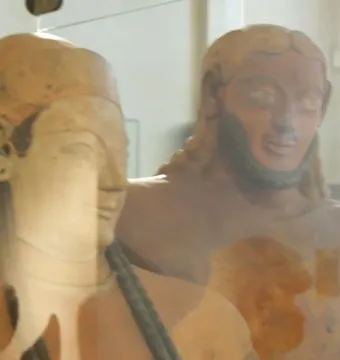
October 2014 © Kikuyu3 · CC BY-SA 4.0
Identification | |
| Title | Sarcophagus of the Spouses |
| Type | Etruscan funerary urn (sarcophagus) for two deceased persons |
| Alternative names | Sarcophagus of Cerveteri; Ehegatten-Sarkophag von Cerveteri; Ehegatten-Sarkophag |
Historical context | |
| Culture | Etruscan |
| Date | Late 6th century BC, circa 520–510 BC |
| Place of production | Caere (Cerveteri), near Rome, Italy |
Discovery and provenance | |
| Related example | Another example of the same type is in the National Etruscan Museum in Villa Giulia, Rome |
| Provenance | Part of the Campana collection; confiscated and sold after Campana's conviction, then acquired in 1861 for the Louvre by Napoleon III |
| Discoverer | Giampietro Campana, an Italian entrepreneur and art collector |
| Discovery date | 1845; also described as around 1850 / in the 1850s |
| Findspot | Banditaccia Necropolis, Cerveteri (ancient Caere/Caisra) |
Physical characteristics | |
| Dimensions | 1.9 m long and 1.1 m wide; alternatively given as 1.11 m × 0.69 m × 1.94 m |
Materials | |
| Material | Terracotta (clay) |
Technique | |
| Construction and finish | Made in four separate sections, each fired separately, then assembled and painted; originally polychrome |
Appearance | |
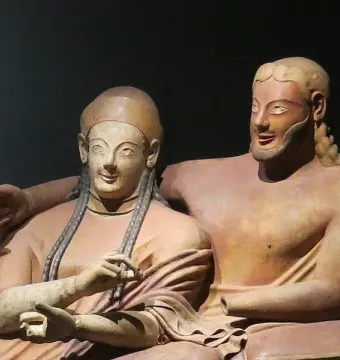
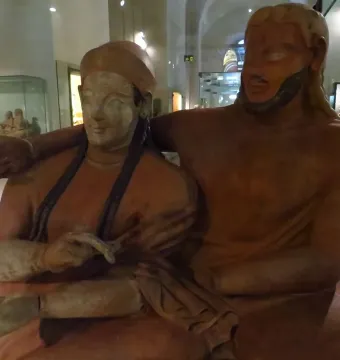
| Facial features | Small almond-shaped eyes, straight nose continuing the forehead line, pointed chin, and a distinct archaic/Ionic-style smile |
| Preservation | Most of the painting survives, though somewhat faded; the Louvre example is missing the man's hand, while the Villa Giulia example preserves the gesture |
| Colors | Male skin dark ochre; female skin pale cream; hair dark; the triclinium mattress/cushion was decorated with multicolored or striped bands |
| Hair | Hair divided into small braids or plaits |
| Pose | Reclining on a triclinium couch in a typical Etruscan banquet pose |
| Female figure | Wears an archaic Etruscan costume with short-sleeved tunic, long skirt, shoes with upturned toes, and a tutulus headdress; she pours perfume into her husband's hand |
| Male figure | Bare-chested, barefoot, with his right arm around the woman's shoulder; his left elbow rests on wine skins or bags |
| Figures depicted | A husband and wife reclining together; the deceased are shown as living banquet guests |
| Form | A double funerary urn in the form of a vase with a lid |
Iconography and meaning | |
| Iconography | The wine skins allude to banquet drinking, and the sculpture presents the spouses as participants in a funerary banquet |
| Meaning | It is often interpreted as expressing the importance of women in Etruscan society |
Location and ownership | |
| Current location | Louvre Museum, Paris, room 420 |
| Inventory number | Cp 5194 |
History and restoration | |
| Restoration | Restored at the Louvre-Lens workshop in October 2013, before the exhibition 'The Etruscans and the Mediterranean' |
| Exhibition | Main/major piece in the exhibition 'The Etruscans and the Mediterranean' (Les Étrusques et la Méditerranée) |
| Exhibition dates | 5 December 2013 to 10 April 2014 |
Significance | |
| Artistic importance | Masterpiece of Etruscan art |
| Cultural significance | One of the significant works of Etruscan funerary culture |