
Sarcophagus of Helena
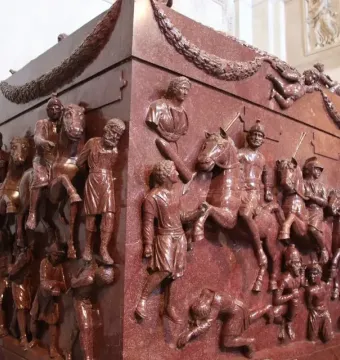
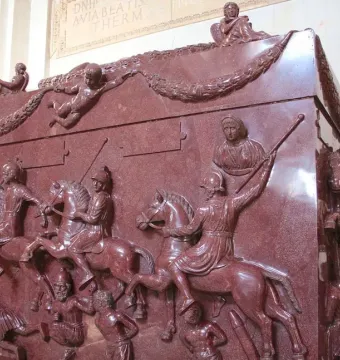
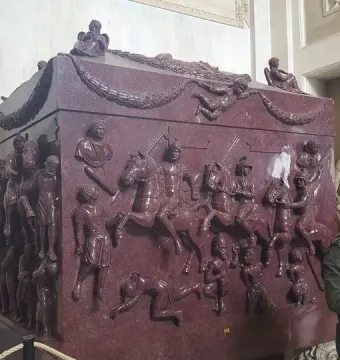
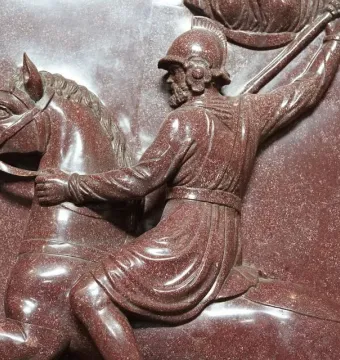
The Sarcophagus of Helena is a Roman sarcophagus from the first half of the 4th century, made for Saint Helena, mother of Emperor Constantine the Great. It is now in the Vatican Museums, in the Museo Pio-Clementino. Carved from red porphyry, it measures 242 cm high, 268 cm long, and 184 cm wide. The sarcophagus was originally in a mausoleum at Tor Pignattara on the outskirts of Rome. Later, its remains were moved and the sarcophagus was reused for Pope Anastasius IV. After severe damage in a fire in the early 14th century, it was transferred to the Vatican Museums in 1777 and restored there. Its sides show battle scenes, with cupids and garlands above, and lion-shaped feet added by Francesco Antonio Franzoni.
August 2019 © Gary Todd · Public domain
September 2011 © Jean-Pol GRANDMONT · CC BY-SA 3.0
April 2017 © Jamie Heath · CC BY-SA 2.0
October 2010 © Dennis G. Jarvis · CC BY-SA 2.0
April 2022 © Fabrizio Garrisi · CC BY-SA 4.0
Identification | |
| Title | Sarcophagus of Helena |
| Type | Roman sarcophagus |
| Alternative name | Sarcophagus of Saint Helena |
Historical context | |
| Art-historical significance | Typical of Constantinian art after the consolidation of power at the end of the civil wars |
| Date | First half of the 4th century, around AD 320 |
| Style | Imperial |
| Dedicated to | Saint Helena, mother of Emperor Constantine the Great |
| Original intended recipient | Probably a male member of the imperial family; earlier hypotheses include Constantius Chlorus or Constantine himself |
| Original use | Built to hold the remains of Helena |
Creator | |
| Workshop or origin of production | Probably made by Eastern workshops or artists, possibly linked to Egyptian porphyry workshops |
Physical characteristics | |
| Measurements | 242 cm high, 268 cm long, 184 cm wide |
| Shape | Rectangular body with a four-sided sloping lid |
Materials | |
| Material | Red porphyry |
| Material properties | A hard stone of great economic and artistic value |
| Historical use of material | In Roman times, only emperors and their families were authorized to use it |
Technique | |
| Technique | Incision and carving |
Appearance | |
| Support | Set on four lion-shaped feet designed by Francesco Antonio Franzoni |
| Garlands | Heavy stylized garlands, including garlands near the corner figures and along the long sides |
| Figures on lid corners | Full-round figures of Genii and Victories at the corners |
| Lion posture | One lion is sleeping and the other is crouched |
| Lid form | Four-sloped lid |
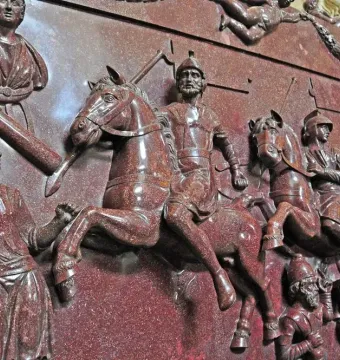
| Main scene | Roman horsemen charging fleeing barbarians or carrying off prisoners, with three on each long side and two on each short side; horsemen wear short tunics and helmets and carry spears, lances, and sometimes shields |
| Upper decoration | Uninscribed insignia with busts on the long sides, possibly personifications of conquered peoples |
| Chest decoration | Smooth chest with figures in medium and high relief |
| Lid decoration | Half-relief figures of Genii and winged Victories, with putti holding garlands; two lions on the lateral sides of the roof |
| Lower decoration | Prisoners in high relief |
Iconography and meaning | |
| Interpretation of decoration | The militaristic decoration suggests it was originally probably made for a male member of the imperial family and not for Helena |
| Bust identities | Right bust probably Constantius Chlorus; left bust probably Helena |
| Stylistic interpretation | Associated with East Greek decorative style and East Greek stylistics |
| Stylistic observation | Its size, material, technique, and sculptural style are described as alien to Roman sculptural traditions |
| Compositional style | The battle scene unfolds on a single plane against a neutral, smooth background |
| Stylistic comparison | The composition recalls the equestrian procession on the base of the Antonine Column |
| Light and shadow effect | High relief against a smooth background creates chiaroscuro effects |
| Art-historical phase | A return to more classicizing modes, with elegant drapery and plastic richness of the bodies |
Discovery and provenance | |
| Transfer to current location | 1777 |
| Original location | Mausoleum of Helena at Tor Pignattara, Rome, between Via Praenestina and Via Labicana |
| Later locations | Mausoleum of Helena in Rome; Basilica of Saint Mary of the Altar of Heaven; Basilica of St. John Lateran; Constantinople |
| Burial association | Saint Helena was buried there; her remains were later transferred |
Location and ownership | |
| Current location | Vatican Museums, Museo Pio-Clementino |
| Displayed near | The sarcophagus of Constantina |
| Collection history | Included in the collection of Pope Pius VI |
History and restoration | |
| Damage history | Severely damaged in a fire at the beginning of the 14th century |
| Later reuse | Used for the burial of Pope Anastasius IV at the Archbasilica of Saint John Lateran in Rome |
| Later placement | By the 17th century it was placed in the portico of the church and rededicated to Helena |
| Restoration | Restored in the Vatican Museums by Gaspare Sibilla and Giovanni Pierantoni; heavily restored, especially at the base and missing parts, in the 18th century |
| Condition | Suffered considerable mutilation |
| Preservation | The general outlines of the scenes, composition, and overall style are original despite restoration |
Other | |
| Associated people | Helena; Constantine I; Constantius Chlorus; Pope Anastasius IV |