
Parthenon Metopes
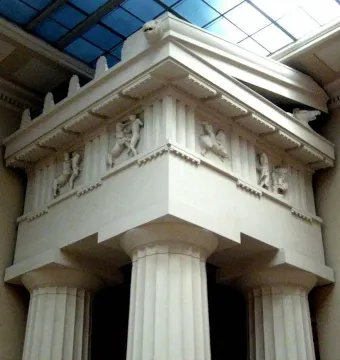
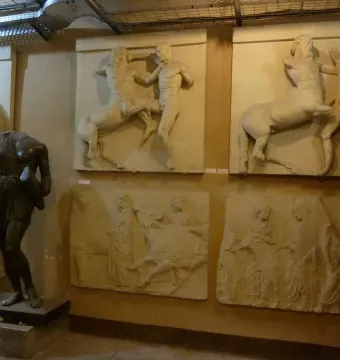
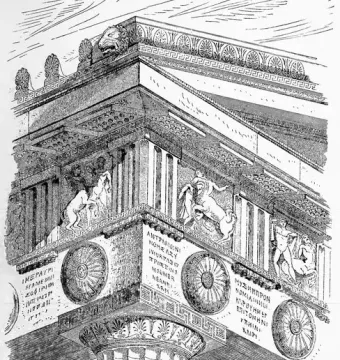
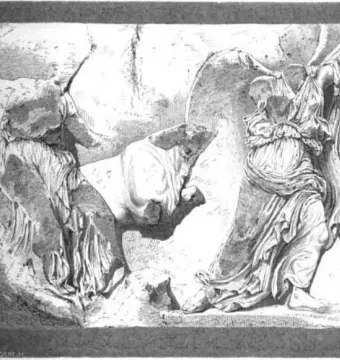
The Parthenon Metopes are a set of ninety-two square panels carved in Pentelic marble, originally placed above the columns of the Parthenon’s peristyle on the Acropolis of Athens. They were made by several artists, probably under the supervision of Phidias, between 447/446 BC and no later than 438 BC. Each metope usually shows two figures, though most are now badly damaged. Their subjects are interpreted as separate battle scenes on each side of the temple: the amazonomachy to the west, the fall of Troy to the north, the gigantomachy to the east, and the battle between centaurs and Lapiths to the south. Many were destroyed in later centuries, and surviving pieces are now in museums in Athens, London, Paris, Copenhagen, and Würzburg.
2009 © shakko · CC BY-SA 3.0
November 2013 © Roland Burckel · CC BY-SA 3.0
1888 © Boetticher, Adolf, 1842-1901 · Public domain
January 1862 © Émile Théodore Therond · Public domain
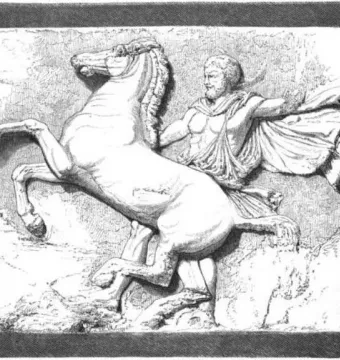
January 1862 © Émile Théodore Therond · Public domain
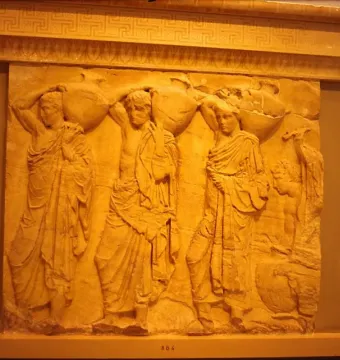
October 2004 © Falk2 · CC BY-SA 4.0
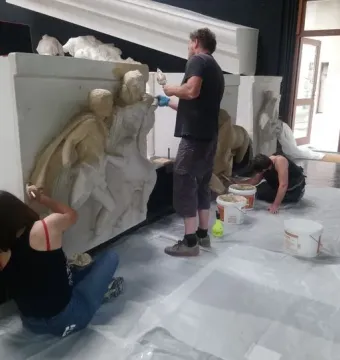
June 2019 © Alex.Sg34 · CC BY-SA 4.0
Identification | |
| Title | Metopes of the Parthenon |
| Part of | The Parthenon |
| Monument | Parthenon |
| Type | Set of sculpted metopes (square relief panels / carved plaques / marble sculptural panels / polychromed metopes) |
Historical context | |
| Date of creation | Between 447 or 446 BC and 438 BC; probably completed around 442 BC |
| Construction period of the Parthenon | 447–438 BC |
| Historical background | After the Persian sack of the Acropolis of Athens in 480 BC and the Greek victories at Salamis and Plataea, the Athenians vowed not to finish the destroyed temples but to leave them as reminders of Persian barbarity |
| Funding context | The Parthenon was part of a building program financed by the treasury of the Delian League after it was transferred from Delos to Athens in 454 BC |
| Purpose of the Parthenon | Not conceived as a temple, but as a treasury to house the colossal chryselephantine statue of Athena Parthenos and the treasure of the League of Delos |
| Architectural order | Doric |
| Decoration program | Traditional in form, with pediments and metopes, but unusual in its proportions; the usual metopes and triglyphs around the sekos were replaced by an Ionic frieze |
Creator | |
| Possible sculptors named in scholarship | Miron, Alcamenes, and possibly Phidias |
| Working method | Made in several stages: drawing the contours, removing the marble outside the drawing down to the back, separating the figure from the background, and finishing the images |
| Workshop organization | Several sculptors may have collaborated, each specialized in one stage of the work |
| Artist attribution | No sculptor is known with certainty |
| Artists | Made by various artists; possibly numerous sculptors collaborated |
| Master builder | Very likely Phidias; possibly with Ictinus, Callicrates, and Phidias overseeing the project |
Discovery and provenance | |
| Original location | Above the columns of the Parthenon peristyle / on the exterior walls of the Parthenon / on the Acropolis of Athens |
| Original number of metopes | 92 |
| Distribution on the building | 14 on the east facade, 14 on the west facade, 32 on the north side, and 32 on the south side |
| Total length of the metopes frieze | About 160 metres |
Physical characteristics | |
| Placement height | About 12 m above ground |
| Relief technique | High relief or very high relief, almost in the round |
| Composition | Usually two figures per metope, shown either in action or in repose |
| Average length | 1.25 m |
| Thickness | 35 cm |
| Height | 1.20 m |
| Shape | Nearly square |
Materials | |
| Material | Pentelic marble |
| Additional materials | Bronze or gilded bronze elements, such as weapons, wheels, or harnesses |
| Coloration | Polychrome: red background; medium blue or dark blue triglyphs; painted eyes, hair, lips, jewelry, and garments; darker male skin than female skin |
Appearance | |
| Numbering convention | Scholars usually number them from left to right using Roman numerals |
| Style and quality | Renowned example of Greek classical high relief; large differences in quality and style among the metopes, with some archaic or conservative, some less accomplished, and some south-side pieces exceptionally skillful |
| Surface treatment | All 92 metopes were sculpted |
Iconography and meaning | |
| Theme by side | West: Amazonomachy; North: Fall of Troy; East: Gigantomachy; South: Centaurs and Lapiths |
| Interpretation status | Interpretations are conjectural, based on barely discernible silhouettes and comparison with other contemporary representations, mainly vases; no ancient description survives that allows a definitive interpretation |
| Suggested symbolism | May evoke opposition between order and chaos, human and animal nature, civilization and barbarism, and possibly East and West; one hypothesis links it to marriage and the breakdown of marital harmony producing chaos |
| Historical interpretation | Often considered a metaphor for the Persian Wars and therefore an exaltation of Athens / the triumph of Athens |
| Civic meaning | Represents the celebration of civic values, including marriage between citizens and daughters of citizens as one of its foundations |
| East side subject | Probably the Gigantomachy; the central metopes may show Zeus and Hera, or Athena, with combats arranged symmetrically around them |
| West side subject | Most commonly interpreted as Greeks fighting opponents in eastern dress, usually identified as Amazonomachy; if the opponents were male, they could be Persians |
| North side subject | The fall of Troy; one metope may represent Menelaus and Helen, and another Aeneas and Anchises |
| South side subject | The surviving metopes at the two ends represent the battle between Centaurs and Lapiths; the central metopes are controversial and may depict an exclusively Athenian conflict between humans and centaurs |
| Relationship to other Parthenon sculpture | Comparable in theme and martial decoration to the chryselephantine statue of Athena Parthenos housed in the Parthenon; part of a unified sculptural decoration program with the pediments and the statue of Athena Parthenos |
| Subject matter | Exclusively martial scenes / purely martial theme |
History and restoration | |
| Destruction history | Most of the metopes were systematically destroyed by Christians when the Parthenon was transformed into a church, around the 5th to 7th century AD; further destruction occurred when an Ottoman powder magazine in the building exploded during the Venetian siege of Athens in September 1687, after a Venetian cannon shot caused the explosion |
| Restoration and transfer history | A fragment kept in Palermo, fragments from the Vatican, the Paul Getty Museum in Los Angeles, and the Shelby White collection in New York have been returned; another fragment previously kept in the Vatican Museums has been returned to Athens |
| Condition | Most of the metopes are badly damaged / very damaged |
| Best-preserved section | The south metopes are the best preserved; the south side is the least damaged by Christian iconoclasm, though affected by the 1687 explosion |
Location and ownership | |
| Current holdings | Fourteen metopes are displayed in the British Museum; one is in the Louvre Museum; the other metopes are in Athens, some still in place on the building |
| Acropolis Museum holdings | 80 metopes were transferred to the Acropolis Museum in Athens in 2005 to protect them from deterioration |
| British Museum holdings | 50 metres of the frieze are in the British Museum, forming the main part of the so-called Elgin Marbles |
| Current dispute | There is an international controversy over the metopes kept in the British Museum; discussions between UK and Greek officials about their future are ongoing, including whether they should remain where they are or be returned to the place for which they were designed |
Significance | |
| Uniqueness | Their number was unprecedented and never repeated / an unprecedented number of metopes, unprecedented in scale |
| Comparative context | The overall decorative program was traditional in form but unprecedented in scope; the pediments were the largest and most complex made up to that date |
Other | |
| Sekos width | 19 m |
| Historical context of the building | After the Persian sack of the Acropolis in 480 BC, Athens launched a vast construction program; the Athenians had sworn not to restore the destroyed temples after Salamis and Plataea, leaving them as a memory of Persian barbarism; Athens grew increasingly hegemonic within the League of Delos |
| Interior layout | Two large rooms: one in the east holding a 12-meter-high chryselephantine statue, and one in the west to house the treasury of the Delian League |
| Associated building construction date | The Parthenon was built between 447 and 438 BC |
| Parthenon dimensions | 30.88 m wide and 69.50 m long |
| Replacement plan | Octastyle, with eight columns on the façade and seventeen on the sides of the peristyle |
| Predecessor plan | Hexastyle |
| Predecessor building | The pre-Parthenon, about which little is known, was under construction when the Persians sacked the Acropolis in 480 BC |
| Attribution and cost | Robert Spenser Stanier proposed a total cost of 10 talents in 1953 |